











Featured

News

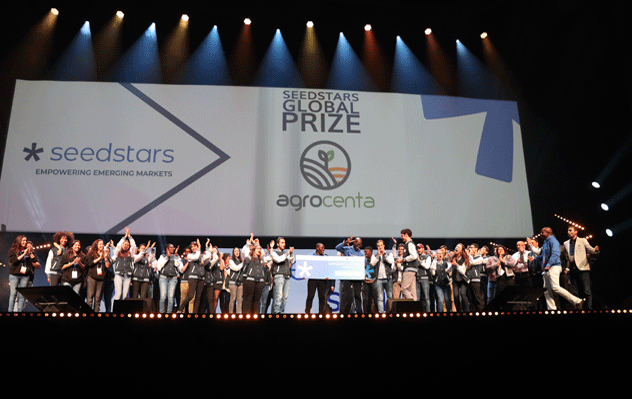
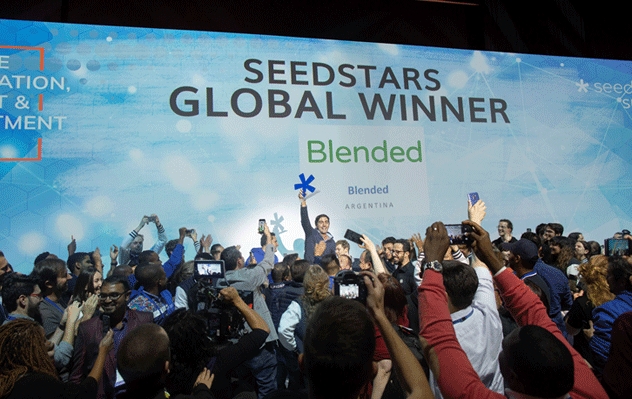
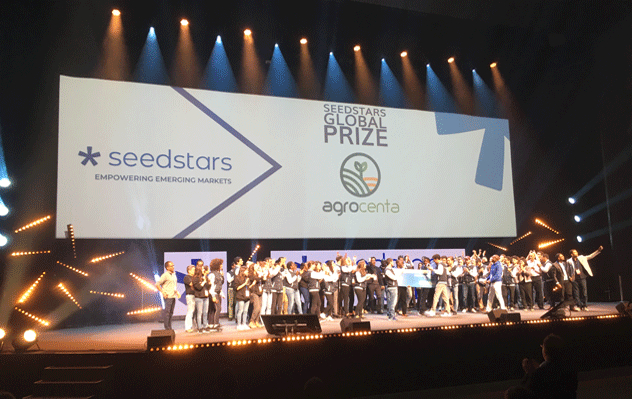
La 5e édition du forum de l’entrepreneuriat dans les marchés émergents, le Seedstars Summit 2018, a réuni les jeunes pousses les plus prometteuses du 9 au 12 avril dernier au Swiss Tech Convention Center de l'EPFL à Lausanne, en Suisse. Au programme, quatre journées intensives de formations et d'ateliers, de rencontres en tête à tête avec investisseurs et mentors, et de témoignages d'entrepreneurs à succès. Au terme de l’événement, la startup agritech ghanéenne AgroCenta a remporté le très en vue concours de pitch parmi 67 finalistes. La compétition par étapes a mis en concurrence pendant un an 5'000 candidats dans 80 villes, avec à la clé un fond d’investissement de 500'000 $.


Grâce à la plateforme d'AgroCenta, ce sont près de 12'000 petits producteurs locaux de millet, de maïs ou de soja qui sont maintenant directement connectés aux entreprises qui achètent leurs produits et en assurent la livraison. Moins d'intermédiaires, plus de revenus pour les paysans : une formule gagnante. Son cofondateur, Francis Obirikorang, vise désormais l'ensemble du continent.


Comme nombre de ses pairs venus d'Amérique latine, d'Afrique, d'Europe centrale et de l'Est, du Moyen-Orient et d'Asie, cet entrepreneur a su conjuguer profit économique et développement durable. En misant sur l'idée que "doing good can make money", il utilise la technologie comme un outil au service de l'amélioration de la vie des gens.


Des idées novatrices pour relever les défis du développement durable

C'est là justement toute l'ambition de Seedstars : améliorer le sort des populations dans les marchés émergents grâce à l'entreprenariat et la technologie, et œuvrer ainsi à la réalisation des objectifs de développement durable des Nations unies. "La technologie a le pouvoir de changer des millions de vie, plus vite que jamais, et l'entrepreneuriat peut apporter des solutions aux grands problèmes du monde", affirme Seedstars. Forte de cette conviction, Seedstars mise donc sur le soutien aux faiseurs de changement dans les marchés émergents. Parce que ces régions abritent 85% de la population mondiale. Mais surtout parce que près de 90% des jeunes de moins de 30 ans y vivent, la fameuse « génération Y ». Ces pays constituent donc des centres croissants d'innovation, des incubateurs d'entrepreneurs, un réservoir impressionnant de talents inexploités !

C'est précisément pour offrir à ces talents potentiels une expertise, une infrastructure, un réseau et des opportunités de financement que les fondateurs ont créé Seedstars en 2012. Partenaire, diplômée d'HEC et charismatique ambassadrice de cette génération des Millennials, Alisée de Tonnac décrit cette "idée suisse" comme un groupe d'investissement visant un impact social dans les marchés émergents. Elle croit à l'effet multiplicateur de ce soutien : au travers des 1'500 entrepreneurs soutenus à ce jour, ce sont plusieurs milliers emplois qui ont été directement ou indirectement créés.


Le meilleur moyen de prévoir le futur, c'est de le créer

Peter Drucker, entrepreneur américain du siècle passé.

Mais l'investissement est bien plus que financier. Seedstars "accélère" - selon le jargon du milieu - les startups les plus prometteuses en leur offrant une visibilité et en les mettant en relation non seulement avec des investisseurs et mais aussi avec des mentors. Elle a créé à cette fin, neuf pôles d'incubation, les Seedspaces, notamment à Genève et au Caire, et bientôt à Abou Dabi et Téhéran. Et organisé plus de 300 événements à travers le monde : des weekends de lancement d’entreprise (launchpad weekends), de fréquentes rencontres, conférences, séminaires. Les ateliers de réflexion qui se sont tenus lors du Forum annuel en Suisse comptent parmi ces derniers. Des investisseurs, mentors, entrepreneurs, représentants de grandes firmes et de gouvernements y ont échangé et débattu de thèmes intéressant les marchés émergents (voir encadré).


La maison intelligente, l'histoire d'un succès pour l’entreprise Enel X

La maison intelligente, dotée de fonctionnalités visant à simplifier la vie de ses habitants et réaliser des économies d’énergie, est capable d'échanger des informations et de l'énergie avec les infrastructures périphériques. Ses secrets et défis ont été présentés aux participants du Forum par l’entreprise Enel X, pour favoriser le transfert de technologie dans les marchés émergents. Comment collecter des données de maisons connectées sans devoir recourir à de nombreux capteurs, dont les prix élevés rebuteraient les consommateurs ? Ou encore, comment s'assurer que les données collectées permettent bien de fournir des services utiles, porteurs d'une réelle plus-value ? Ce sont autant de thèmes qui ont été abordés lors des échanges. Outre les recommandations de recourir aux énergies renouvelables ou de mettre à profit les heures creuses, mieux connaître et contrôler sa consommation d'énergie s'avère une nécessité pour favoriser les économies. L'internet des objets représente une solution prometteuse mais requiert des systèmes connectés et intégrés ainsi qu’une centralisation des données collectées. L'industrie manufacturière a un rôle important à jouer en ce sens, afin d’équiper les appareils électroménagers d'outils de mesure de la consommation d'énergie.

Le commerce électronique international : des avantages mais pas que

Phénomène mondial, la croissance du commerce en ligne comporte des avantages et des inconvénients pour les marchés émergents, ainsi que l'ont souligné les représentants de Fedex qui ont animé le débat. D'une part, international et lié à l'essor des médias sociaux, le cybercommerce offre une vitrine qui va bien au-delà des frontières et donc une opportunité à saisir pour les pays émergents. Chacun peut devenir «a global player», avantagé par sa connaissance du marché local. En effet, de bons produits peuvent être vendus à de bons prix partout dans le monde à condition de bien connaître les caractéristiques des clients potentiels, en particulier les dimensions culturelles, religieuses ou traditionnelles. Mais d’autre part, du fait également de sa dimension internationale, le commerce à distance est très difficile à réglementer. Comment un pays, comme par exemple les Etats-Unis dans le cas de Facebook, pourrait-il réglementer l'activité d’une société d'e-commerce basée sur son territoire alors que la majorité de ses utilisateurs se situent au-delà des frontières nationales ?


Riche de près d'une communauté de 60'000 startups, investisseurs, institutions publiques, grandes entreprises, monde académique, pouvoirs publics et média, Seedstars souhaite « inspirer et connecter », comme l’explique sa directrice Alisée de Tonnac. Pour établir une connexion directe entre ses membres, la communauté dispose désormais d'un outil de communication privilégié : le réseau social de l'application Seedstars Community. Seedstars offre également une formation à la création d'entreprise sur 6 mois, la Seedstars Academy, qui vise à transformer une idée innovante en un « produit minimum viable » (MVP) générateur de revenu. Enfin, le programme et fonds d'investissement Seedstars Growth accompagne les startups sélectionnées lors du Seedstars World vers une levée de fonds en Série A (objectif de rentabilité, développement sur un plan national, prémices d'internationalisation).

Le Seedstars World : beaucoup d'appelés, peu d'élus

Lancée pour la première fois en 2012, la compétition annuelle Seedstars World se déroule par étapes dans plus de 70 pays émergents. Son but : repérer les talents en leur demandant de réaliser un pitch sur leur projet d'affaires. Elle s'adresse aux jeunes pousses dégageant un revenu mensuel d'au moins 10'000 $ et dont la levée de fonds n'excède pas 500'000 $. La sélection repose pour l'essentiel sur le potentiel d'expansion à l'international et la solidité de l'équipe en place. Depuis 5 ans, quelques 12'000 candidats se sont pressés au portillon. Seuls 300 ont été retenus. Ils ont alors ont pu se présenter devant un parterre d'investisseurs lors de la finale au Seedstars Summit.

Cet événement représente aussi pour eux une opportunité extraordinaire d'apprendre d'entrepreneurs plus expérimentés, d'étoffer leur réseau et de promouvoir leurs projets. Pour cette 5e édition, les finalistes ont présenté 900 pitches, et bénéficié de 400 rendez-vous avec des investisseurs et de 220 sessions de mentoring avec 57 entrepreneurs expérimentés. L'un de ces derniers, Brian Moelich, issu de la Silicon Valley et fondateur au Canada de la société de conseil en innovation Arrisio, a dispensé - gratuitement - à une dizaine de startups, un conseil personnalisé pour développer un modèle d'affaire reproductible.


Des entrepreneurs inspirants, mais peu de femmes

Les participants au sommet ont également pu assister à différentes allocutions. Steffen Ehrhardt, Internationalisation & Startups Lead EMEA chez Google, a ainsi partagé son expérience en insistant sur la nécessité d'accepter la dimension expérimentale d'un projet en développement : la "culture de l'échec", mal vue en Europe, mais essentielle à ses yeux. En matière d'expansion internationale, il a mis l'accent sur l'importance de connaître les territoires que l'on veut conquérir et recommandé dans cette optique de constituer des équipes diversifiées et multiculturelles.


La compréhension du contexte était également au cœur de la présentation de l'infatigable entrepreneure de Singapour Gwendolyn Regina, actuellement en résidence chez Entrepreneur first, citant l'exemple d'un mendiant chinois ayant adapté sa sébile au mode de payement le plus répandu autour de lui : le téléphone portable. Pour pénétrer l'apparent chaos asiatique, elle conseille aux jeunes entrepreneurs : "avancez lentement et vous finirez par traverser la rue bondée".


Gwen Regina compte parmi la minorité de femmes de ce monde très masculin de l'entreprenariat technologique. Dans un effort pour les encourager alors que près de 89% de ses alumni sont des hommes, Seedstars leur dédie un prix : la Best Woman Entrepreneur. Cette année, il a couronné la nigérienne Vivian Nwakah, fondatrice de Medsaf dont la plateforme logistique en ligne qui relie directement les entreprises pharmaceutiques aux hôpitaux, cliniques et pharmacies, offrant ainsi une parade au grave problème de la contrefaçon de médicaments.


Lire aussi: Seedstars Summit 2018 : focus sur le Moyen-Orient et l'Afrique du Nord
Economy

Algeria

10 Mar 2015

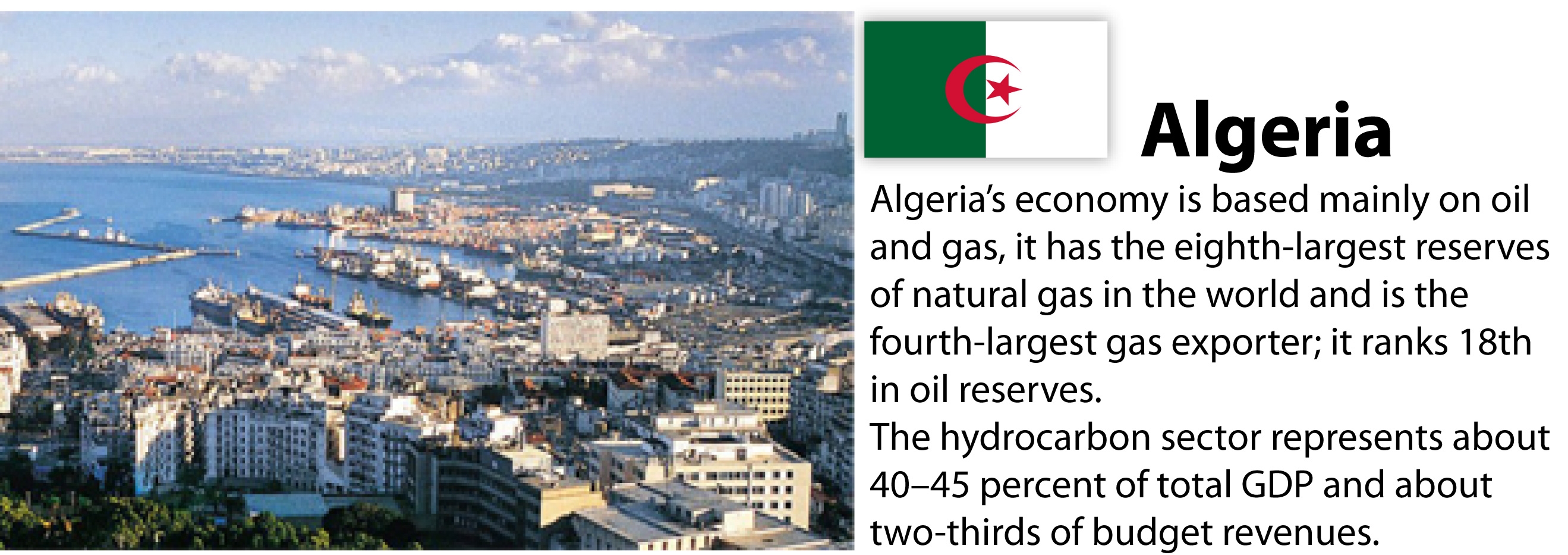
  Economy of Algeria Algeria’s economy is based mainly on oil and gas, it has the eighth-largest reserves of natural gas in the world and is the fourth-largest gas exporter; it ranks 18th in oil reserves. The hydrocarbon sector represents about 40–45 percent of total GDP and about two-thirds of budget revenues. Oil and gas resources account for 98 percent of the country’s exports and 70 percent of tax revenues. The chief challenges that Algeria faces in the short and medium terms are the need to diversify the economy, strengthen political and economic reform, improve the business climate, reduce regional inequalities and create jobs. Structural reform within the economy, such as development of the banking sector and the construction of infrastructure, moves ahead slowly. According to the World Bank indicator for ease of doing business in 2015, Algeria is ranked 154 out of 183 economies.   Essential Information   Area: 2,381,741 sq kmCapital: AlgiersPrincipal Towns: Oran, Constantine, Annaba, Stiff, Blida, Sidi Bel Abbes, Skikda, Batna, Tlemcen.Languages: Arabic is the official language but French is still widely used. There are Berber-speaking minorities.Climate: The coast has a moderate climate with temperatures ranging from 13 to 32°C. The summer months of June to September can be hot and humid with daytime temperatures registering between 27 and 32°C; these can be exceeded, for brief periods, when the hot, dry sirocco wind blows from the southCurrency: 1$ = 78.9 Algerian dinar (DZD). DEMOGRAPHY 39,5 (Million 2015 est.) (source: IMF) 0-14 years: 28.4% (male 5,641,148/female 5,378,207) 15-24 years: 17.4% (male 3,451,069/female 3,291,166) 25-54 years: 42.8% (male 8,398,770/female 8,209,634) 55-64 years: 6.2% (male 1,230,865/female 1,186,832) 65 years and over: 5.2% (male 931,769/female 1,094,262) (2014 est.) Source: CIA factbook. EducationLiteracy: definition: age 15 and over can read and write total population: 80.2% male: 87.2% female: 73.1% (2015 est.) (Source: CIA factbook). NATURAL RESOURCESpetroleum, natural gas, iron ore, phosphates, uranium, lead, zinc Fossil FuelOil - proved reserves: 12.2 billion bbl (January 2012 est.)Natural gas - proved reserves: 4.502 trillion cu m (1 January 2011 est.) MineralsIron ore, phosphates, uranium, lead, zincHydro-electric0.3% of production Visa Requirements: Nationals from the following countries do not require a visa to travel to Algeria:Libyan Arab Jamahiriya, Malaysia, Maldives, Mali, Mauritania, Morocco, Democratic Republic Sahraoui, Seychelles, Syrian Arab Republic, Tunisia, Yemen.Non-resident foreigners must change the equivalent of AD 1,000 on entering the country. WTO accession: Observer Independence Day July 5 Current local time  Weather Find the Algerian Diplomatic representation in Switzerland  

Bahrain

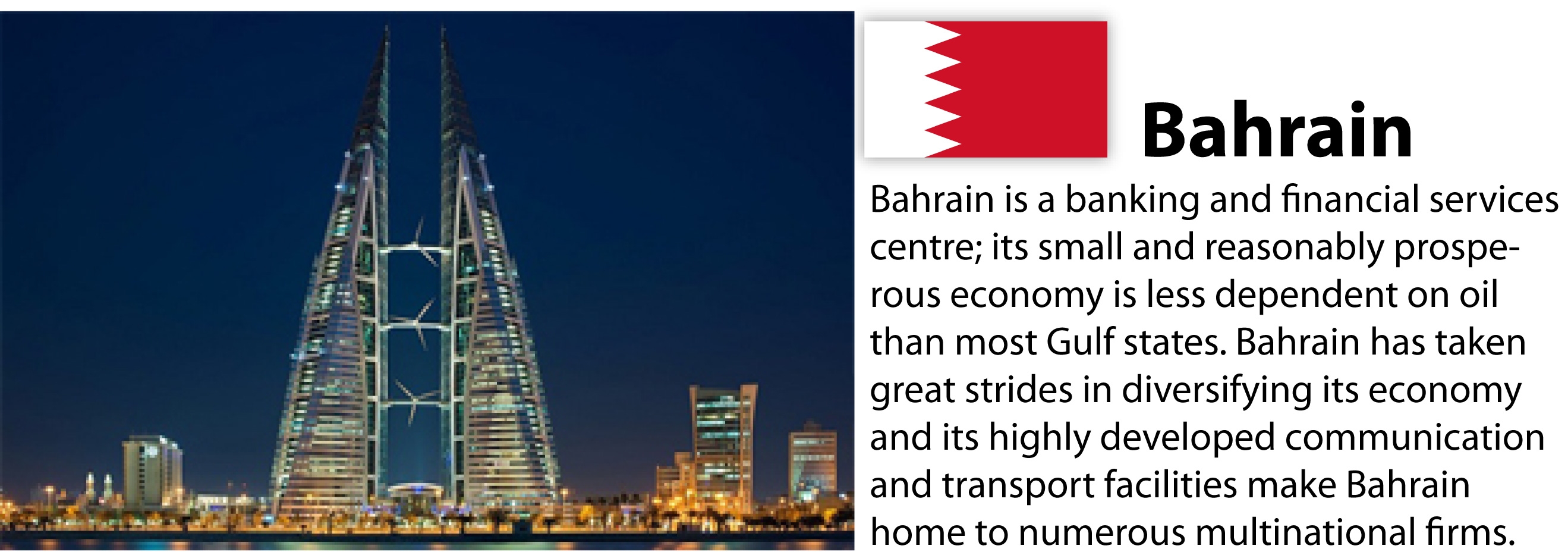
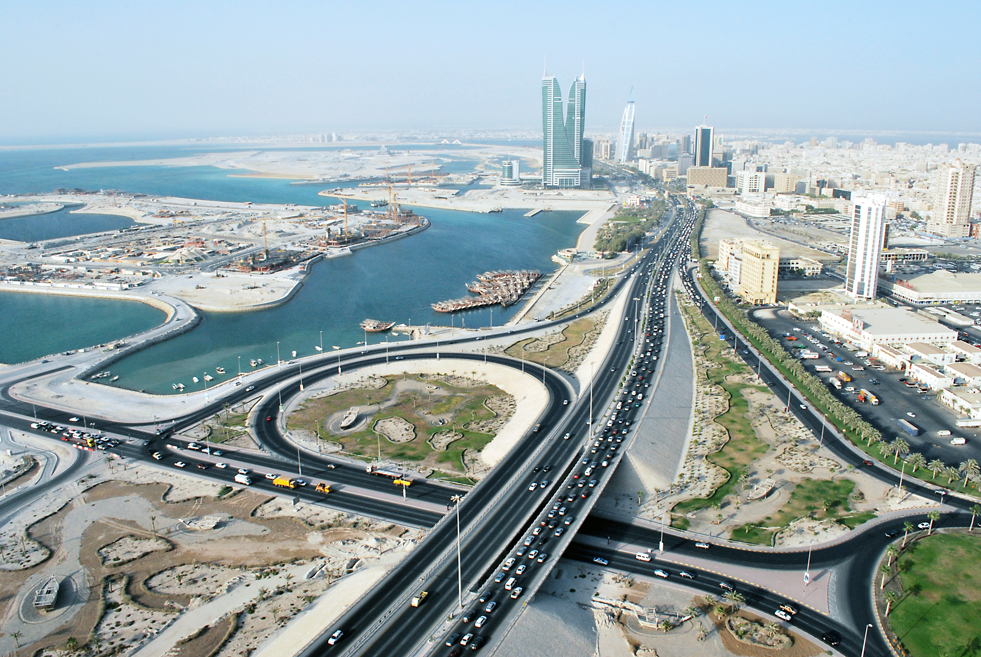
  Bahrain is a banking and financial services centre; its small and reasonably prosperous economy is less dependent on oil than most Gulf states. Bahrain has taken great strides in diversifying its economy and its highly developed communication and transport facilities make Bahrain home to numerous multinational firms with business in the Gulf. Bahrain's economy, however, continues to depend heavily on oil. Petroleum production and refining account for more than 60% of Bahrain's export receipts, 70% of government revenues, and 11% of GDP. Other major economic activities are production of aluminum - Bahrain's second biggest export after oil - finance, and construction. Bahrain competes with Malaysia as a worldwide center for Islamic banking and continues to seek new natural gas supplies as feedstock to support its expanding petrochemical and aluminum industries. The country’s limited oil reserves, which are expected to last only another 10 to 15 years, have led Bahrain to already make significant progress on developing the non-oil sector. Other major segments of Bahrain's economy are the financial and construction sectors. The financial sector contributes around 27 per cent of the kingdom’s GDP, while hydrocarbons contributes around 25 per cent. Manufacturing contributes around 13 per cent. The Kingdom is the main banking hub for the Gulf and a centre for Islamic finance with a total size of $800 billion, which has been attracted by the strong regulatory framework for the industry.   Essential Information Area: 695.25 sq kmPopulation: 1.3 millionCapital: Manama Principal Towns: Muharraq, Jidhafs, Isa Town, Awali, Hidd, Rifaa.Area: 695.25 sq kmPopulation:1.3 millionCapital: ManamaPrincipal Towns: Muharraq, Jidhafs, Isa Town, Awali, Hidd, Rifaa.Languages: Arabic is the official language. English is used widely in business circles.Gross Domestic Product (official exchange rate): $26,5 billion (2012 est)GDP per capita: $20,385 (2012 est.)International Reserves: $5.0 billion (2012 est.)Climate: Tropical Gulf climate with hot summers, mild winters and high year-round humidity. The annual average rainfall is only some 70 mm.Currency: 2.64 US Dollar (USD) = nearly 0.377 Bahraini Dinar (BHD)           Visa Requirements: No visa is required for GCC and British nationals. Other travellers must obtain entry visas in countries where there is a Bahraini consulate, these can then be extended locally. Travellers with an onward reservation may obtain a 72-hour transit visa at the point of entry. Bahrain National Day 16 December Current local time  Weather Bahrain Diplomatic representation in Switzerland  

Comoros

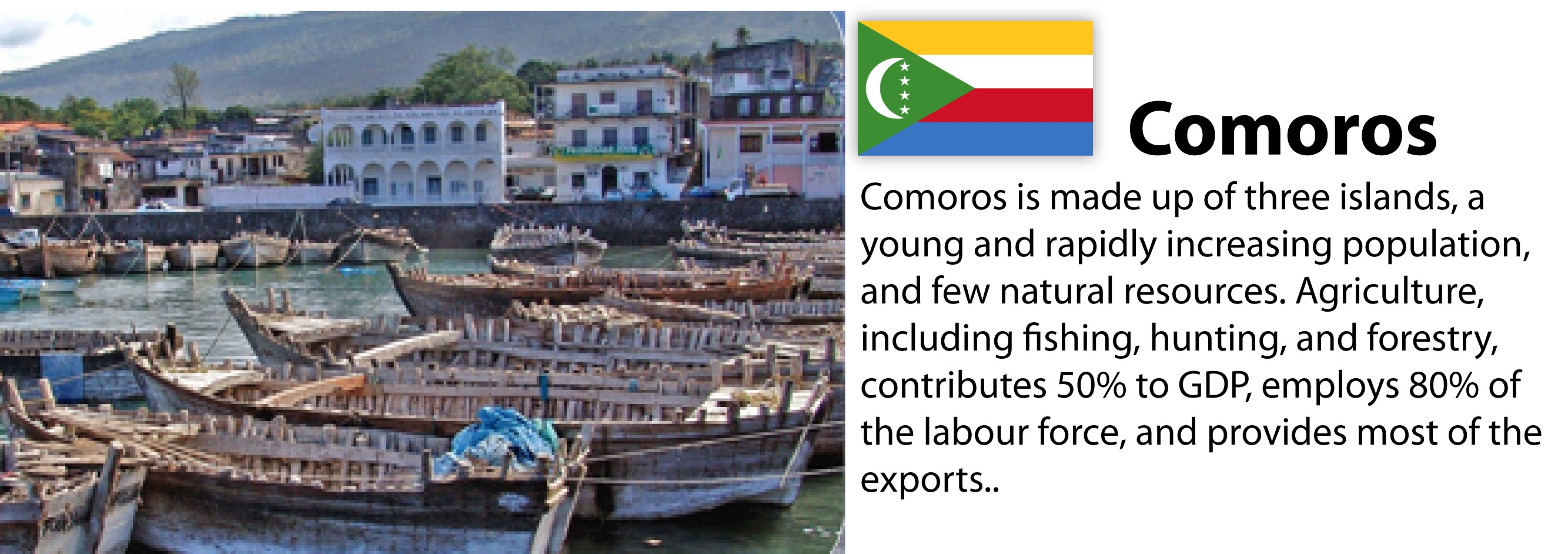
  Comoros is made up of three islands that have inadequate transportation links, a young and rapidly increasing population, and few natural resources. The low educational level of the labour force contributes to a subsistence level of economic activity, high unemployment, and a heavy dependence on foreign grants and technical assistance. Agriculture, including fishing, hunting, and forestry, contributes 50% to GDP, employs 80% of the labour force, and provides most of the exports. Export income is heavily reliant on the three main crops of vanilla, cloves, and ylang-ylang; and Comoros' export earnings are easily disrupted by disasters such as fires. The country is not self-sufficient in food production; rice, the main staple, accounts for the bulk of imports. The government is struggling to upgrade education and technical training, privatize commercial and industrial enterprises, improve health services, diversify exports and promote tourism. Remittances from 150,000 Comorans abroad help supplement GDP.  The international donor community currently plays a modest role in the country’s development. According to the OECD statistics, Comoros received approximately US$25 million in development assistance in 2005. France was by far the largest donor contributing almost $17 million followed by UN agencies (including the World Bank) with over $7 million and the EC with over $4 million. Further, the economy is also significantly dependent upon remittances from the estimated 150,000-strong Comorian Diaspora in France and elsewhere. Economic development in the past two decades has been hindered by a combination of recurrent political crises, macro-economic imbalances, and external shocks. A gradual recovery of the economy is observed since 2008. Real GDP is driven by agriculture and services increased by 0.6% in 2008, 1.1% in 2009 and 2.1% in 2010.   Essential Information      Area: 2,170 sq kmPopulation:795,000 (July 2011 est.) Capital:MoroniPrincipal Towns:Fomboni, Moutsamoudou, DomoniLanguages: Arabic and French are the official languages while Comoran, a blend of Swahili and Arabic, is also spoken. Gross Domestic Product (purchasing power parity):$872 million (2012 est.) Gross Domestic Product (official exchange rate):$595 million (2012 est.) GDP per capita: $1,300 (2012 est.) Reserves: 6.2 months of imports of goods and services (2009 est.)Climate: The coast has a moderate climate with temperatures ranging from 13 to 32°C. The summer months of June to September can be hot and humid with daytime temperatures registering between 27 and 32°C; these can be exceeded, for brief periods, when the hot, dry sirocco wind blows from the south. The Sahara desert is hot and arid with daytime temperatures reaching 43°C while night temperatures fall to 10°C or less. Currency: Comoros Franc (KMF) = nearly 0.00281 US Dollar (USD) Visa Requirements: A valid passport and onward/return ticket are required. A three-week entry visa, which may be extended, may be obtained from the airport on arrival. Travellers should obtain the latest details from the nearest Mission of the Federal Islamic Republic of the Comoros.   Comoros' National Day 6 July   Current local time  Weather Diplomatic representation of Comoros in Switzerland  

Djibouti

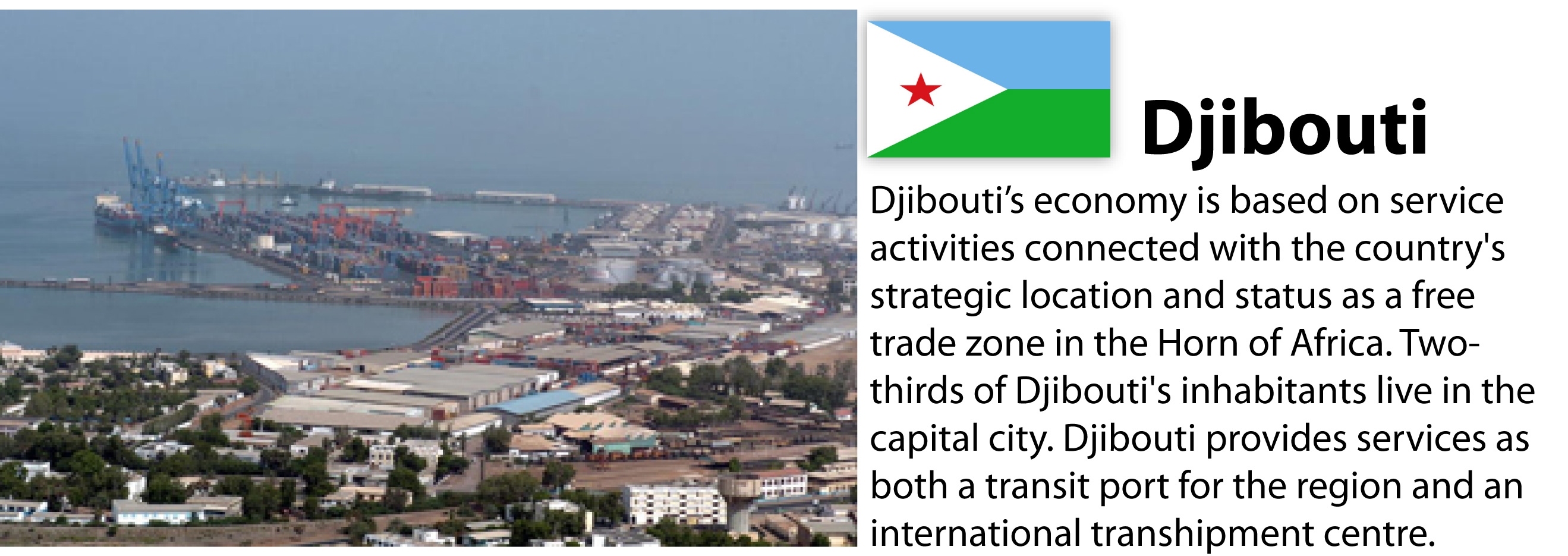
  Djibouti’s economy is based on service activities connected with the country's strategic location and status as a free trade zone in the Horn of Africa. Two-thirds of Djibouti's inhabitants live in the capital city; the remainder are mostly nomadic herders. Djibouti provides services as both a transit port for the region and an international transhipment and refuelling centre. Imports and exports from landlocked neighbour Ethiopia represent 70% of port activity at Djibouti's container terminal. Djibouti has few natural resources and little industry. The nation is, therefore, heavily dependent on foreign assistance to help support its balance of payments and to finance development projects.  The Djiboutian economy has benefited from huge investment in the transport sector namely; port investment, construction and banking sector during the last years. Foreign direct investment (FDI) as well has registered a positive evolution in the last ten years. With the aim of strengthening Djibouti's position as a hub for trade, logistics and related services, as well as a provider of financial services, several road corridors were opened or renovated in 2010. Nevertheless, the economy remains little diversified and highly dependent on port operations in the tertiary sector. This accounts for 76% of GDP, while the primary sector contributes a mere 3.9%. The country depends almost entirely on imports for its food supply. Domestic agricultural production covers only 10% of the country's food needs.  Djibouti is at the crossroads of major sea routes for trading oil and other goods, and wants to become a hub for commercial, logistical and financial services for the Gulf of Aden countries. The government has launched a 4.3 billion US dollar (USD) investment programme, and in 2012, funding was obtained to build new port facilities for salt and potassium exports.  The government is also drafting a long-term development strategy called Vision 2035, and a study is being done of which leading sectors could diversify the sources of national growth and create jobs. Essential Information     Area: 23,200 sq km Population: 792,198 (2013 est.) Capital: Djibouti Principal Towns:Dikhil, Tadjoura, Obock Languages: Arabic and French are the official languages. Afar, Amharic and Somali are also widely spoken. Gross Domestic Product: $1.4 billion (2012 est.) GDP per capita: $1,767 (2012 est.) GDP per capita (PPP): $2,700 (2012 est.) Gross Official Reserves: $0.2 billion (2012 est). Climate: Very hot and arid from April to August with average temperatures of 32°C but reaching 45°C. October through March is slightly cooler with occasional light rain. Currency: 1.00 USD ≈ 179.7 Djiboutian Franc (DJF), 1.00 DJF = 0.00556 USD. Visa requirements: Visas are required by all visitors, except French nationals, on short stay visits. Ten-day visas are available on arrival for US and EU nationals - an onward ticket is also required.    Djibouti National Day, 27 June. Current local time  Weather Diplomatic representation of Djibouti in Switzerland  

Egypt

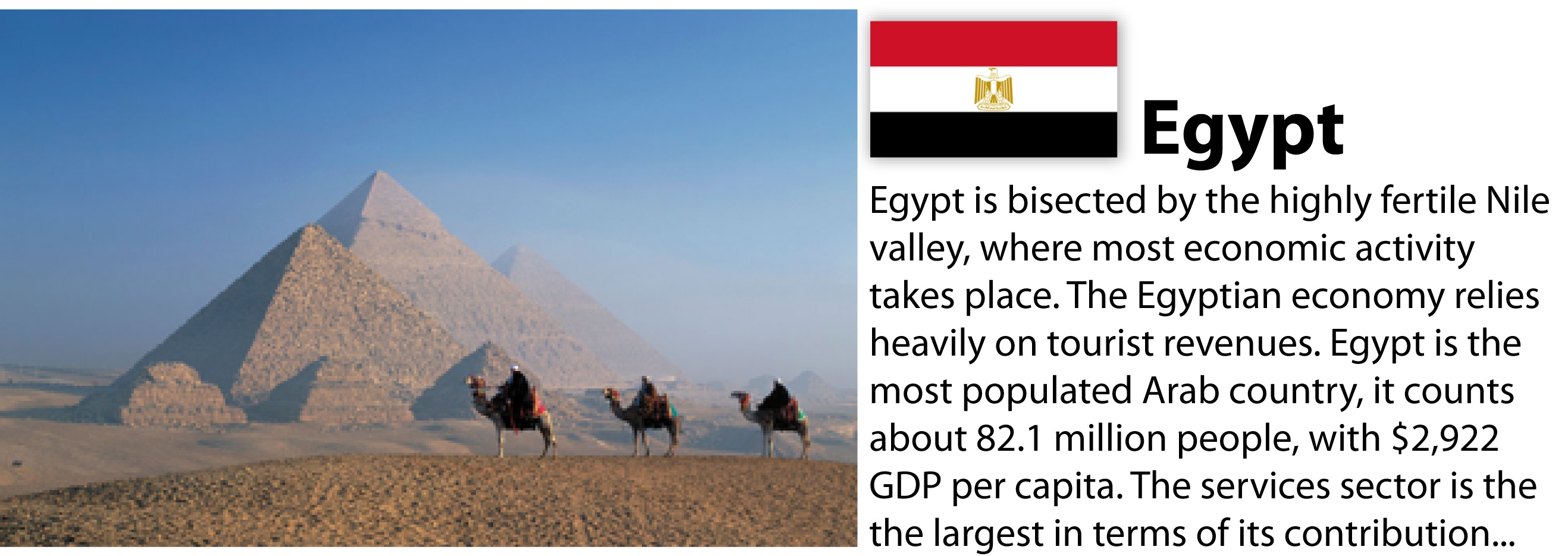
  Egypt is bisected by the highly fertile Nile valley, where most economic activity takes place. The Egyptian economy relies heavily on tourist revenues. Egypt is the most populated Arab country, it counts about 82.1 million people, with $2,922 GDP per capita. The contribution of the Egyptian economy is about 0.3% of the emerging markets index MSCI. Egyptian population is rather young. The aged 15 years or less, about 34%, and the age group of youth from 15-35 years old about 35%.  The people who represent the workforce in the category of 15-65 years old represent 62%, which requires a clear map to take advantage of the power work in economic activity. The services sector is the owner of the largest share in terms of its contribution to the GDP of the acquisition of more than 50%, while the contribution of industry and agriculture, two sectors that offers a real job opportunities, permanent and constitute a measure of value added is 37.7% and 13.1% subsequently. The rising contribution of services sector because of its education and health services, provided by public institutions. On the other hand, the tourism sector is considered historically a main source of Egypt’s national income with some 12 million tourists visiting Egypt and spending about $11 billion annually.Egypt’s economy is still suffering from a severe downturn and the government faces numerous challenges as to how to restore growth, market and investor confidence. Political and institutional uncertainty, a perception of rising insecurity and sporadic unrest continue to negatively affect economic growth. Real GDP growth slowed to just 2.2 percent year on year in October-December 2012/13 and investments declined to 13 percent of GDP in July-December 2012. The economic slowdown contributed to a rise in unemployment, which stood at 13 percent at end-December 2012, with 3.5 million people out of work. Foreign exchange reserves have continued to decline to reach about 3 months of imports. Essential Information  Area: 1,002,000 sq kmPopulation: 85,3 Million (2012 est.) Capital: CairoPrincipal Towns: Alexandria, Tanta, Damietta, Suez, Port Said.Languages: Arabic is the official language; French and English are both widely used, particularly in business circles. Gross Domestic Product: $255billion (2012 est.)GDP per capita: $2,989International Reserves: $15.72 billion Climate: Generally warm and dry from November to March although day temperatures can rise to over 38°C. April to October can see periods of intense heat in Cairo and Upper Egypt. Rainfall is limited to the northern, coastal region. A hot and dusty desert wind, the Khamaseen, blows in April/May and August/September.Currency: 1$ ≈ 6.8 Egyptian Pound (EGP) DEMOGRAPHYAge Distribution (2012 est.) 0-14 years: 32.5% 15-24 years: 18.2% 25-54 years: 38.1% 55-64 years: 6.5% 65 years and over: 4.7%  Population Growth 1.92% (2012 est.) Education71.4% of the total population age 15 and over can read and write  NATURAL RESOURCESFossil FuelPetroleum, natural gas MineralsIron ore, phosphates, manganese, limestone, gypsum, talc, asbestos, lead, zinc  Hydro-electricAssuan and Nasser Dams Visa: All visitors must be in possession of a valid passport and a visa. Travellers should ensure that their passports extend for three months from the date of the visa being issued. Where this date may be exceeded intending visitors are advised to renew their passports beforehand as persons found with non-registered passports can be liable to a £E 20 fine. One-month tourist and seven-day transit visas are available at Egyptian ports, airports and frontier posts; even so it is preferable to obtain visas before travelling.  National Day 23 July. Current local time  Weather Diplomatic representation of Egypt in Switzerland

Doing business

Egypt Accelerates Investment Reforms and Prepares New State-Owned Company Listings

Egypt’s Minister of Investment and Foreign Trade, Mohamed Farid Saleh, announced that the government plans to intensify efforts to improve the business environment and reduce bureaucratic obstacles, while preparing to li…

Opinion

4th Industrial Revolution, but for whom?

  By Ayman Abualkhair   (النسخة العربية) Nowadays, much is being said on the 4th Industrial revolution. The world has gone through three industrial revolutions during the last two centuries. The First Indus…

Finance

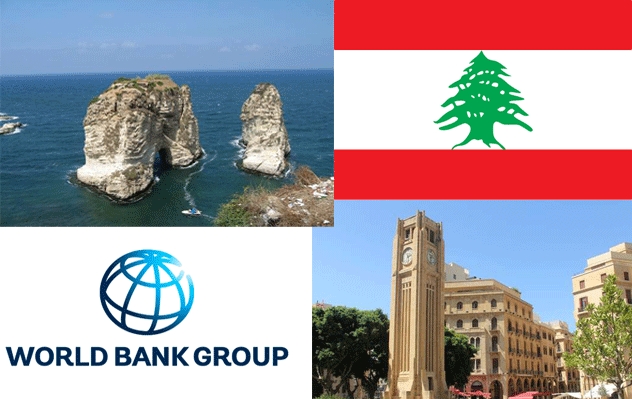
World Bank Group Allots US$200 Million for Road Repairs in Lebanon

  World bank   (Version Française) (النسخة العربية)    The World Bank Group has earmarked US$200 million for upgrading Lebanon’s road network, seen as a risk to public safety as well as an impediment to urban-rural …

Diplomatic corner

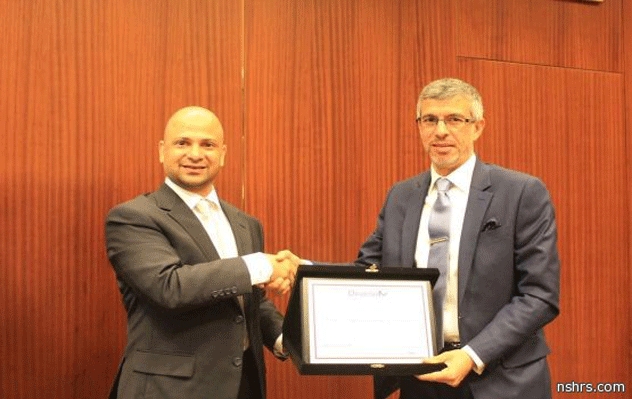
وفد دايركشن المعرفية يزور جنيف ويكرم السفير السعودي الجديد لدى منظمة التجارة العالمية الدكتور عبد العزيز بن محمد الواصل

  نقلا عن موقع "نشر"   قام وفد رحلة دايركشن المعرفية والثقافية بزيارة الى جنيف في السادس والعشرين من شهر كانون الثاني/ يناير من هذا العام حيث التقي سعادة السفير الدكتور عبد العزيز بن محمد الواصل المندوب الدائم لوفد ال…

Reports

Algeria Launches 2026 Oil and Gas Bid Round to Attract New Foreign Investment

22 Apr 2026

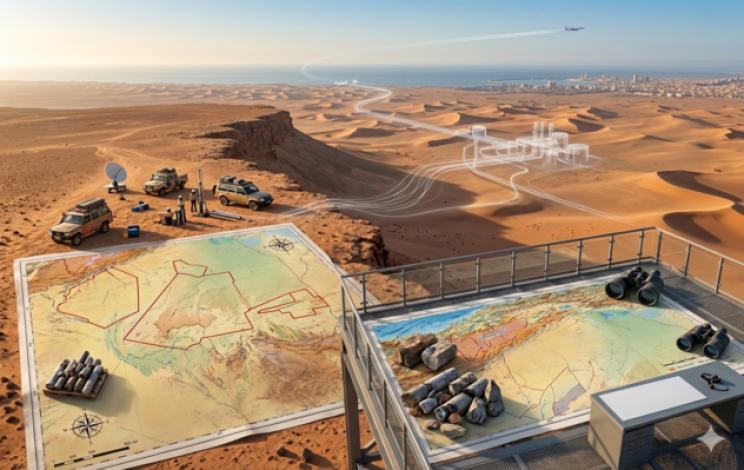
Algeria officially launched a new licensing round for the oil and gas sector, titled "Algeria Bid Round 2026." The move aims to bolster production and attract Foreign Direct Investment (FDI) into the energy sector, the country’s primary source of foreign currency. The bid round includes seven exploration blocks stretching across fields in Ogla, Illizi, Touggourt, and El Bayadh. These areas are believed to hold significant oil and natural gas reserves, positioning them among the most prominent investment opportunities in North Africa this year. This initiative is part of a broader government strategy to revitalize the energy upstream sector and solidify Algeria’s position as a regional gas hub, particularly amid rising global demand for energy sources following the supply chain disruptions of recent years. According to the Algerian Ministry of Energy, the process will enter a technical phase in June 2026, during which project data will be opened to international firms, followed by briefing sessions and technical consultations. Final bids are expected in November 2026, with contracts slated for signing in January 2027. These will include production-sharing contracts (PSCs) or partnership agreements with the state-owned oil giant, Sonatrach. Through this round, Algeria seeks to draw new global energy players into the local market at a time when it is working to scale up production levels and improve the investment climate in a sector that serves as the backbone of the national economy. Its substantial gas reserves further cement its role as a key player in the European and Mediterranean energy markets. The move also highlights a gradual shift in Algeria’s investment policy—moving from traditional reliance on national companies toward a model more open to foreign capital. By offering flexible contractual incentives via production-sharing models, the state aims to mitigate risks for international investors and incentivize entry into high-cost exploration projects. Ultimately, the "Algeria Bid Round 2026" reflects a clear effort to reposition Algeria on the global energy investment map by linking untapped natural resources with foreign capital and technology, amidst a wide-scale reshaping of global energy supply and demand dynamics.

Egypt Ranks Third Regionally in Investment Attractiveness: Insights into Fitch’s FDI Inflows Report

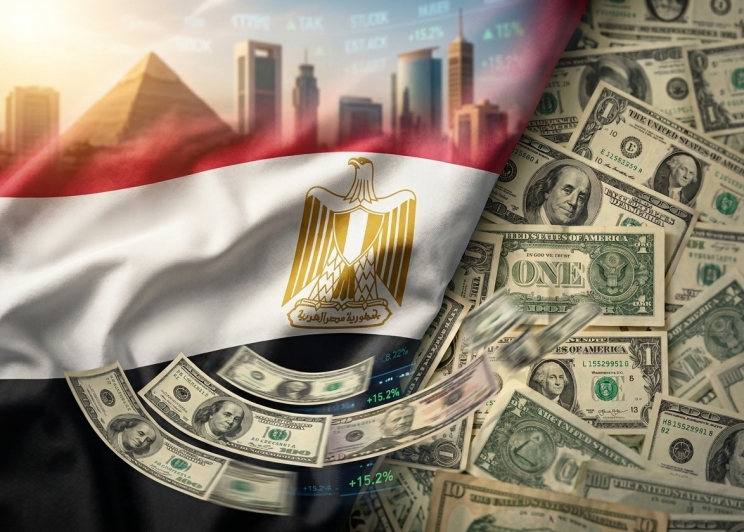
A report by Fitch Ratings—reviewed by the Egyptian Cabinet’s Information and Decision Support Center (IDSC)—revealed that Egypt ranked third among 18 markets in the Middle East and North Africa (MENA) region in terms of investment openness. Globally, Egypt secured the 27th position out of 202 countries, a metric reflecting a relative improvement in its standing on the global investment map. The report indicates that this ranking reflects Egypt's capacity to attract Foreign Direct Investment (FDI) inflows, bolstered by a diversified investment landscape. Key sectors include oil and gas, automotive manufacturing, ICT, food industries, renewable energy, infrastructure, and financial services. This sectoral diversity demonstrates the breadth of the Egyptian economy and its multiple investment catalysts, moving away from reliance on a single sector or limited economic axis. Fitch attributes the improvement in investment flows to several structural factors, including economic growth, a strategic geographic location linking Asia, Africa, and Europe, low labor costs, and a wealth of human talent. This is further supported by a massive domestic market, abundant energy sources, and a tourism sector that remains a long-term draw for capital. Additionally, the report notes the increasing role of Gulf-based financing, which has become a primary source of foreign capital in Egypt in recent years. In the same vein, the report suggests that a flexible exchange rate policy, in alignment with International Monetary Fund (IMF) recommendations, is expected to support the stability of foreign currency inflows in the short and medium term by enhancing the economy’s resilience to external shocks and boosting investor confidence. Egypt aims to attract approximately $60 billion in FDI between 2026 and 2030—a target the report deems relatively achievable, given that annual inflows typically range between $9 billion and $11 billion, excluding exceptional mega-projects. The report contrasts this figure with total investment flows into the African continent, which often remain below $60 billion annually, highlighting the scale of Egyptian ambition relative to its regional context. The report also highlights Egypt's position as a premier investment destination in North Africa, with growing interest from multinational corporations in the industrial, pharmaceutical, and electronic sectors. It notes that the Egyptian government has taken significant steps in recent years to enhance the investment climate, including the implementation of the unified approval system for investment licenses, known as the "Golden License." This system allows for the establishment and operation of projects within a relatively short timeframe of approximately 20 working days, reducing administrative hurdles and accelerating investment entry. The legislative framework has been further strengthened by Investment Law No. 72 of 2017 and its subsequent amendments, which provide tax incentives and guarantees for investors, including facilitating the repatriation of profits and ensuring equality between local and foreign investors. Recent amendments under Law No. 160 of 2023 introduced further incentives, alongside efforts to improve the geographical distribution of investments across the country. Regarding future sectors, the report points to a surge in interest in renewable energy. Fitch expects Egypt to lead the region in solar and wind capacity growth, driven by reforms initiated in 2014 that allowed private sector participation in electricity production and the gradual reduction of energy subsidies. The government aims to increase the contribution of renewable energy to 42% of total electricity production by 2030, a goal currently being met ahead of schedule. The report also sheds light on the expansion of investments in coastal development and tourism, particularly in the North Coast region, alongside the continued importance of the real estate sector, which contributes roughly 20% of GDP, reflecting its deep integration into the macroeconomy. Fitch confirms that Egypt possesses the largest stock of FDI in North Africa. The United Arab Emirates emerged as the largest investor in the country during 2024 and 2025, followed by the United States, the United Kingdom, Italy, Saudi Arabia, and Kuwait, reflecting a diversified base of foreign capital sources. In summary, the report presents a dual image of Egypt as an investment hub: on one hand, there is clear progress in the legislative framework, attractive sectors, and capital flows. On the other hand, actual performance remains tied to the economy's ability to translate these structural advantages into sustainable, long-term inflows within a highly volatile regional and international environment.

Saudi Arabia and Switzerland: A Strategic Partnership from Historical Roots to the Horizons of Vision 2030

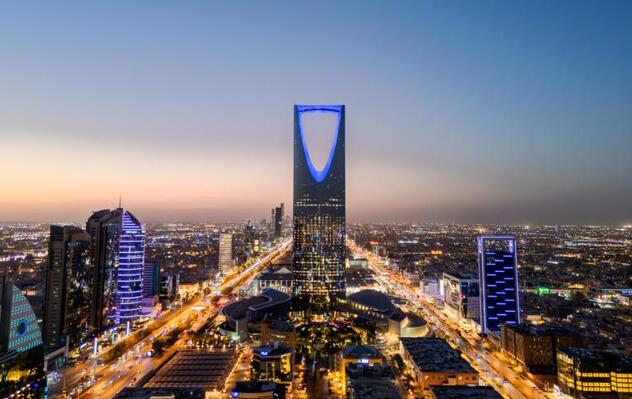
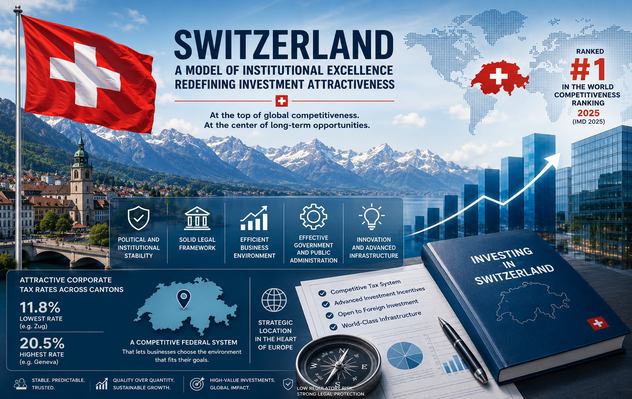
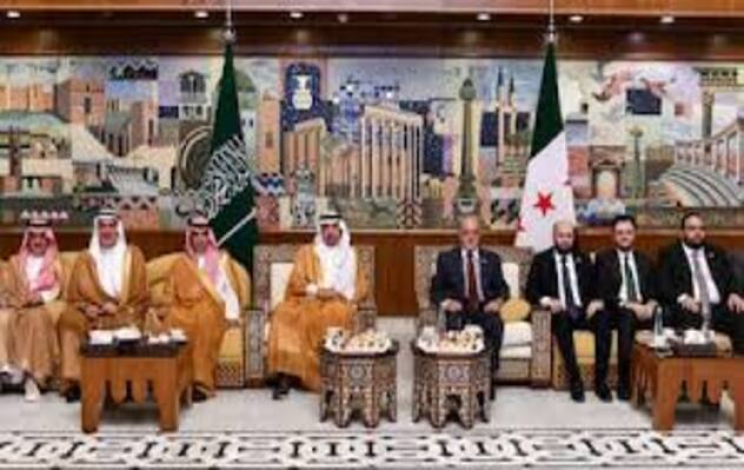
The bilateral relationship between the Kingdom of Saudi Arabia and the Swiss Confederation represents a continually evolving partnership. Grounded in a long history of mutual understanding, it has now entered a new phase characterized by strategic depth, particularly in light of the ambitious Saudi Vision 2030. While Switzerland is a global hub for innovation, finance, and technological expertise, Saudi Arabia stands as the region's largest economy and a gateway for monumental developmental transformation. This confluence of interests creates a vital intersection for collaboration in the fields of entrepreneurship, sustainability, and technology. Historical Foundations of Diplomatic Relations The institutional connection between the two countries dates back many decades, with Switzerland recognizing the newly established Kingdom of Saudi Arabia in 1927. However, formal diplomatic relations were only established in 1956. This relationship saw a significant economic turning point with the formation of the Saudi-Swiss Joint Economic Commission (JEC) in 1975. Since then, the JEC has served as the primary platform for enhancing cooperation in economic, trade, investment, scientific, and technical domains. The relationship has been strengthened by high-level reciprocal visits, underscoring Switzerland's role as a trusted partner, even playing a crucial diplomatic role in representing Saudi and Iranian interests in 2017. Analysis of Economic Relations and Investment Opportunities The Kingdom of Saudi Arabia is currently ranked as Switzerland's second most important trading partner in the Middle East (after the UAE). The total trade volume between them amounts to approximately CHF 6.8 billion (including gold), with Swiss exports accounting for over CHF 6 billion of this figure. Furthermore, the cumulative investment of Swiss companies in Saudi Arabia reached about CHF 1.41 billion by the end of 2022. While this economic volume is an indicator of mutual trust, the biggest driver for future growth is Vision 2030. This unprecedented economic shift has offered vast opportunities for numerous Swiss companies to participate in "Giga-projects" such as NEOM, Qiddiya, and the Riyadh Expo 2030. This direction was affirmed during the recent 14th Joint Economic Commission meeting, where discussions emphasized the need to finalize bilateral legal agreements, such as improving the implementation of the Free Trade Agreement between EFTA states and the GCC, and expediting the conclusion of a new Investment Protection Agreement (IPA). Partnership in Transformation Pillars: Technology, Sustainability, and Entrepreneurship The new Saudi-Swiss partnership is focused on three main pillars, as the Kingdom seeks to leverage Switzerland’s extensive expertise to accelerate its non-oil economic diversification. 1. Technology and Innovation Switzerland is a world leader in technological education and innovation, hosting institutions like the Swiss Federal Institute of Technology in Zurich (ETH Zurich), which is globally prominent in areas such as Artificial Intelligence and Robotics. This expertise aligns perfectly with Saudi Arabia's ambition to become a global technology power, especially after its leadership in global digital development indices. Technological cooperation is evident in several forms: AI and Digital Transformation: Specialized Swiss companies are seeking opportunities to integrate solutions in AI, Blockchain, and even the Metaverse into vital Saudi sectors. Digital Infrastructure: Swiss firms are participating in building the advanced digital infrastructure that supports projects like NEOM, which relies entirely on cutting-edge technologies. 2. Sustainability and CleanTech Sustainability holds paramount importance in the partnership, particularly with Saudi Arabia's adoption of ambitious climate initiatives, including the NEOM Green Hydrogen projects, set to be the world's largest of their kind. CleanTech Forum: The two nations hosted the First Saudi-Swiss CleanTech Forum in 2023, gathering Swiss SMEs that offer innovative solutions for climate change mitigation. Knowledge Transfer: Saudi Arabia benefits from the "bottom-up" Swiss approach to innovation, which focuses on funding basic research in universities and supporting start-ups in renewable energy and environmental solutions. 3. Entrepreneurship and Business Localization The Kingdom views the private sector, including Swiss companies, as an essential engine for achieving development goals, specifically in job creation and economic diversification. Figures indicate that Saudis hold a positive perception regarding the availability of entrepreneurial opportunities and the necessary skills to launch a business. The Localization Challenge: As the market grows more attractive, Saudi Arabia has introduced new policies to ensure value localization.The most prominent is the Regional Headquarters (RHQ) program, which requires foreign companies to move their regional headquarters to the Kingdom to secure government contracts. Additionally, the Economic Participation Policy (EPP) has been adopted, mandating a local economic participation of at least 35% in certain public procurement contracts. Swiss Response: Despite the complexity of these rules, about ten Swiss companies have already responded by relocating their regional headquarters to the Kingdom.This reflects the strategic importance they attach to the opportunities in the Saudi market. Furthermore, cooperation in the hospitality and tourism sector through partnerships for qualifying Saudi tourism competencies is evidence of Swiss expertise penetrating new sectors. Future Outlook and Strategic Trajectory The relationship between Saudi Arabia and Switzerland is currently at its strongest point, having evolved from a traditional trade partnership into a strategic alliance aimed at building the future. Vision 2030 serves as the driving force connecting the robustness of the Swiss economy with Saudi Arabia's ambitious push for diversification. While the Kingdom imposes regulatory challenges (such as RHQ and EPP) to ensure value localization, the fields of CleanTech, Artificial Intelligence, and entrepreneurship remain ideal areas for deepening this cooperation, establishing it as a model for partnership between a developed European economy and an ascending regional power.

UAE's Reno, a Home Renovation Tech Platform, Secures $4 Million to Fuel GCC Expansion

Reno, a technology platform based in the UAE specializing in home renovation and interior design, has successfully closed a $4 million funding round, comprised of a mix of equity and debt. The funding is specifically aimed at building the region's first end-to-end operating system for renovation processes. The round was led by prominent investors, including Sanabil 500, Hub71, Plus VC, Zero 100 VC, FlyerOne Ventures, Sandstorm VC, AngelSpark, and the Swiss Founders Fund. Leading Home Renovation with AI Technology Founded in 2024 by Marc Michel, Amr Hosny, and Farah Karabeg, Reno positions itself as a comprehensive, all-in-one platform for interior design and renovation across residential and commercial projects. The current funding will support the launch of Reno’s new app in early 2026, which is set to introduce innovative features, including: Real-time AI-powered design. Instant budget estimates. An Intelligent Materials Engine, providing customers with complete clarity from the very start of their renovation journey. A Comprehensive and Transparent Business Model Unlike traditional renovation services, Reno integrates all stages of the renovation process into a single platform, covering design, project management, contractor oversight, and financing options. One of its signature offerings is the "Renovate Now, Pay Later (RNPL)" financing option. This model provides a transparent, structured, and fully supervised renovation experience, giving homeowners and property investors unmatched control and visibility through AI-driven workflows and transparent, milestone-based processes. Control and Growth for Investors: Ibrahim Shami, CEO and Co-founder of Seraya (one of the fastest-growing short-term rental operators in the UAE), leveraged the RNPL financing options to renovate multiple units without paying upfront. Reno's support helped him double his portfolio's renovation pace from two to four apartments per month, effectively turning a renovation "bottleneck into an opportunity to expand faster and smarter." Reducing Stress for Families: For a customer like Camillo Schobesberger, a busy professional, the platform-driven approach transformed his renovation into a smooth, structured experience thanks to daily updates, clear budget oversight, and milestone-linked payments. He noted that the platform "made the renovation journey smooth for my family, minimising disruption," and the carefully managed upgrades "increased my property value by nearly 40%." Expansion Outlook Marc Michel, Co-founder and CEO of Reno, stated: "Our goal is to make home renovations as seamless and transparent as possible." With the new $4 million funding, Reno plans to expand its geographical footprint across the GCC region, scale its technology capabilities, and continue to refine the renovation experience. By leveraging innovation and data-driven workflows, Reno is redefining how renovations are managed, helping clients save time, reduce stress, and maximize their property value.

TERN Group Raises $24 Million to Expand Partnerships Across Europe and the Gulf

TERN Group, an AI-powered global workforce-mobility platform for healthcare professionals headquartered between the UK and the UAE, has secured $24 million in a Series A funding round, bringing its total capital raised to $33 million. The round was led by Notion Capital (UK) with participation from EQ2 Ventures (UAE), RTP Global, LocalGlobe, Leo Capital, Presight Capital, and investor Tom Stafford, co-founder of DST Global. Founded in 2023 by Avinav Nigam and Krishna Ramkumar, TERN trains, certifies, and places healthcare professionals from 13 countries, cutting international hiring timelines from 6–12 months to under 10 weeks. The new funds will be used to: Scale the company’s AI platform. Enhance training and compliance infrastructure. Strengthen partnerships with healthcare providers across the Gulf region while supporting growth in Europe and the UK. CEO Avinav Nigam emphasized TERN’s mission to make global healthcare hiring faster and more transparent, noting the UAE’s rapidly growing demand for skilled professionals—healthcare spending there is projected to exceed $50 billion by 2029. The platform already serves more than 650,000 healthcare professionals and over 100 healthcare organizations, offering end-to-end solutions including résumé analysis, compliance tracking, and initial interviews, with a support team that assists candidates with training, relocation, and cultural integration. Notion Capital highlighted TERN’s ability to address the global shortage of healthcare workers by combining AI-driven efficiency with strict regulatory compliance, making it a trusted partner for health systems in the UK, UAE, Germany, and beyond. With this investment, TERN Group plans to accelerate expansion in the Gulf and deepen integration with regional health systems, building a sustainable workforce infrastructure that enables hospitals and governments to meet rising healthcare demand efficiently and confidently.

About Us

Enjoy the power of entrepreneurs' platform offering comprehensive economic information on the Arab world and Switzerland, with databases on various economic issues, mainly Swiss-Arab trade statistics, a platform linking international entrepreneurs and decision makers. Become member and be part of international entrepreneurs' network, where business and pleasure meet.


Contact Us

Please contact us : 

Cogestra Laser SA

144, route du Mandement 

1242 Satigny - Geneva

Switzerland