WTO Public Forum 2025, Trade, trust and transformation in the age of AI
The Public Forum is the World Trade Organization’s largest platform for connecting decision-makers from the public and private sectors worldwide. This year’s edition takes place against the backdrop of significant recent developments, most notably the United States’ decision to impose steep tariffs on the majority of its trading partners—including Europe, China, and developing countries. These measures carry profound implications for the future of international commerce.
Organized over two days, this year’s Forum aims to explore the role of digital transformation in redefining the global trading system and in fostering connectivity, innovation, and international cooperation. Participants are set to assess both the risks and opportunities presented by a rapidly evolving suite of digital tools designed to empower small businesses, expand market access, and sustain a more resilient digital trade environment.
Compared to previous years, the number of sessions has been pared back slightly to ensure a sharper focus on core issues facing global trade today. More than 350 speakers are expected to share their insights on harnessing the transformative potential of digital trade.
Day One opened with a high-level discussion organized in partnership with the Peterson Institute for International Economics (PIIE), examining how business leaders across the globe are navigating a trading system where trust, predictability, and cooperation are being tested as never before.
The 2025 Forum zeroed in on how digital transformation, particularly artificial intelligence (AI), is redefining trade. While AI holds promise to streamline logistics, reduce trade costs, and expand market access, the Forum repeatedly stressed that its benefits will not be automatic. Bridging digital divides, ensuring fair competition, protecting jobs, and restoring trust in multilateralism are the pillars on which inclusive growth must rest.
The discussions revolved around three interconnected dynamics: trust, predictability, and transformation. From the opening plenary to sessions on Africa’s trade potential, digital economy agreements, and the social costs of trade conflicts, participants pointed to the same challenge: how to ensure the global trading system adapts to 21st-century realities while keeping inclusivity at its core.
Opening session
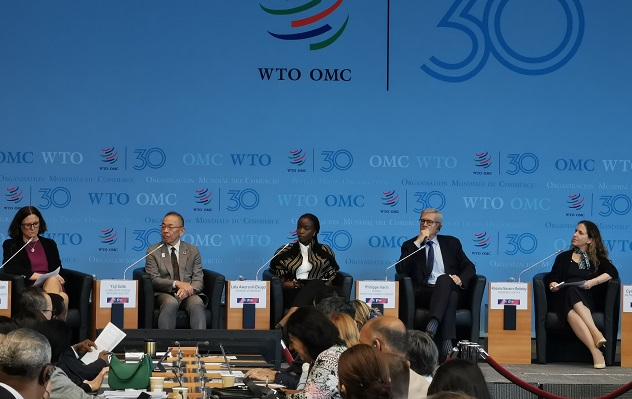
The first day of the Public Forum began with a panel organized in partnership with the Peterson Institute of International Economics (PIIE), exploring how business leaders around the world are navigating today’s global trading system, where trust, predictability and cooperation are increasingly tested.
A bent system, not a broken one
The Forum’s first morning, co-hosted with the Peterson Institute for International Economics, put the question of trust and predictability squarely on the table. Director-General Ngozi Okonjo-Iweala dispensed with hand-wringing. Roughly 72% of global goods still move under WTO terms, she noted, a reminder that the multilateral core continues to do much of the world’s commercial heavy lifting. But the core is under stress. Governments are reaching for unilateral tools; firms are absorbing more policy risk than they can easily price; consumers are learning that geopolitics now comes bundled with their household goods.
The business leaders on stage were clear about the costs of unpredictability. Cynthia Sanfilippo of L’Oréal offered a simple causal chain: predictable rules lower frictions; lower frictions raise trade; more trade raises growth and prosperity. When rules are rewritten overnight, complex ecosystems of suppliers, skills and jobs can fray in days. Rosario Navarro Betteley of Chile’s SOFOFA put a small, open economy’s dependence in stark terms: half of Chile’s GDP rides on trade. For such economies the multilateral rulebook is not a luxury; it is a life-support system. “There is no Plan B.”
From Japan, Yoji Saito of Mitsubishi described how a single sudden export restriction can ricochet through supply chains, forcing costly substitutions, delaying procurement and throwing production schedules into disarray. The victims are not only multinational primes; the shock propagates quickly to small suppliers with thin margins and little negotiating power. Philippe Varin, chair of the International Chamber of Commerce, gave the macro version: costs are mounting, especially for SMEs, and when “bandwidth” to cope with disruption runs out, exporters simply give up.
The collective message was clear: reforms must restore both credibility and agility to a system that shapes corporate strategies and supports household livelihoods. The mood was not one of despair but of urgency. No one in the room called for a return to some frictionless world that never truly existed. Instead, the call was for what global trade has always needed to thrive—credible rules, real transparency, and processes nimble enough to keep pace with technology without collapsing under political strain. That is precisely why the Forum’s other headline—the launch of the World Trade Report 2025—carried such weight.
Launching the World Trade Report 2025: AI meets trade, promise with conditions
The launch of the World Trade Report 2025 was another highlight. Its projections are striking: In summary, according to the report AI could raise cross-border trade by up to 37% and boost global GDP by 12–13% by 2040, provided infrastructure, openness, and cooperation align. Gains would extend beyond digital services to physical trade, as AI streamlines customs, logistics, and compliance.
Yet, the report cautions that without policy action, AI risks widening divides. Internet access, broadband quality, and digital skills remain deeply uneven. A “tech divergence” scenario could see rich economies capturing most benefits, while low-income economies lag. Conversely, narrowing digital gaps could nearly double gains for the poorest countries.
The labor market findings were equally sobering. While real wages are expected to rise, transitions will be disruptive. The Director-General warned against repeating past mistakes of underinvesting in reskilling and social safety nets, which had fueled backlash in earlier waves of globalization.
The session, chaired by Director-General Ngozi Okonjo-Iweala and joined by Deputy Director-General Johanna Hill, WTO economist Marc Bacchetta, and a high-level panel of experts, set out to examine the implications of artificial intelligence for trade and growth.
Okonjo-Iweala was blunt in her opening: the global trading system may be enduring its worst disruptions in eight decades, but AI could be one of the few bright spots—if economies seize the moment. The report, she explained, shows that AI is a “general-purpose technology” on par with electricity or the internet. It is already transforming how goods and services are produced, exchanged, and consumed. The question is whether it will serve as a force for convergence or deepen the divides between and within economies.
The economics are striking. WTO simulations suggest that by 2040, the value of cross-border trade could be 34–37% higher than today’s trajectory, delivering what the authors call a “40 by 40” effect: nearly 40% more trade within 15 years. Global GDP could meanwhile be 12–13% larger. The fattest gains, predictably, are in digitally deliverable services—from cloud computing and AI-as-a-service to remote diagnostics and analytics. But the gains are not confined to code. AI is already cutting compliance costs, automating customs clearance, optimising shipping routes, translating across languages and even strengthening contract enforcement. These are the very frictions that often strangle cross-border commerce; shaving them yields real dividends.
And yet the report’s message was clear: inclusion will not happen by default. Internet penetration is near-universal in high-income economies but still a minority experience in the poorest. Broadband speed, affordability, and digital skills mirror the gap. Policy readiness is also starkly uneven: while two-thirds of high-income economies have adopted AI strategies, only a handful of low-income countries have done the same.
The WTO economists ran the numbers across scenarios. In a “tech divergence” world, where poorer countries fail to catch up on infrastructure and adoption, incomes by 2040 rise about 14% in rich economies, 11% in middle-income economies, and just 8% in low-income ones. In contrast, in a “policy catch-up” world, where the digital divide narrows and uptake spreads, low-income economies’ gains almost double to 15%, with middle-income economies rising to 14%—all without curbing rich-country growth. The distributional story of AI, in short, is not technology’s fate but policy’s choice.
Labour markets emerged as another pressure point. Globally, the models still show real wages rising across skill groups, but the skill premium—the wage advantage of the highly educated—narrows slightly, by 3–4%. AI, in practice, substitutes more for routine and even some advanced tasks than for low-skilled, non-routine ones. That may help temper inequality. But the transition will not be smooth. As Okonjo-Iweala warned, much of today’s political backlash against trade is rooted in the failure to invest in education, reskilling and social safety nets during earlier waves of globalisation. “We cannot afford to repeat this mistake with AI.”
The launch panel echoed the report’s themes. Ralph Ossa stressed that governments still have levers—lowering barriers to AI-related goods and services, easing data flows, and supporting open trade. Hua Wang highlighted how small firms, from beekeepers in Niue to artisans in Africa, are already using AI to scale into global markets. Tomas Lamanauskas of the ITU delivered a cold reminder: Africa hosts 20% of the world’s population but just 2% of its data centres. Bridging that gulf requires investment on a scale no single actor can deliver. And Amandeep Singh Gill, the UN’s Tech Envoy, called for AI governance to be treated as a global public good, with trade policy anchoring cooperation rather than allowing fragmentation.
The World Trade Report 2025 thus arrived not as a glossy annual but as a strategic warning. AI can be the next great engine of trade and inclusive growth—but only if governments invest in infrastructure, education, and trust-building frameworks. Left unattended, it risks becoming another wedge in an already fragmented system.
The supply base of the AI economy
Trade is not just a conduit for the gains; it is the circulatory system of the AI economy itself. In 2023 the world traded US$2.3 trillion of AI-enabling goods: critical minerals, semiconductors, high-performance computing kits and myriad intermediate inputs. Add to those the traded services—cloud capacity, model training, data labelling—and the picture is clear. Open markets lower costs and spread capabilities; fragmented markets raise costs and concentrate them.
Some fragmentation is already visible. Quantitative restrictions on AI-related goods have climbed from around 130 in 2012 to nearly 500 in 2024, driven mostly by high- and upper-middle-income economies. Tariff bindings in some low-income economies still reach 45% on AI-relevant hardware. Restrictions on cross-border data flows and proliferating export controls further hobble diffusion. There are reasons of security, privacy and competition policy behind many of these measures. But here, too, the report’s message is one of balance: cooperation and interoperability can manage risks without suffocating innovation.
Bridging Digital Divides Through Local Solutions
The session “Bridging Digital Divides Through Local Solutions” at the WTO Public Forum highlighted how grassroots actors are reshaping the digital landscape by creating inclusive and community-driven solutions. While global conversations on digital trade often focus on high-level policy, corporate strategies, and regulatory frameworks, the panel underscored the vital role of everyday innovators — from youth-led ventures and women entrepreneurs to indigenous communities and cooperatives — in closing digital divides.
Moderated by Tian Wei, Host at China Global Television Network, the discussion brought together voices from diverse regions and sectors, each showcasing how local innovation can foster more equitable participation in the digital economy.
Grassroots innovation and empowerment
Melissa Kariuki, Founder and CEO of Whip Music Africa, emphasized how digital tools are opening new opportunities for young African creators to showcase and monetize their talent globally. She highlighted the challenges faced by artists, particularly women, in accessing fair platforms. “Local solutions must start with trust and access,” she noted, pointing to the need for inclusive infrastructures that reflect community realities.
Justin Langan, Founder and Executive Director of O’Kanata, shared insights from indigenous communities in Canada. He described how digital platforms can empower indigenous youth to tell their own stories, preserve cultural heritage, and engage with global audiences on their own terms. Langan stressed that bridging divides is not just about connectivity, but also about cultural recognition and digital sovereignty.
Building inclusive markets
From Latin America, Danilo Miranda De La Espriella, CEO of BloomsPal, illustrated how digital marketplaces can strengthen small agricultural producers. By connecting farmers directly with consumers through digital platforms, his initiative supports fairer trade conditions and greater resilience for rural communities.
Ajaita Shah, Founder and CEO of Frontier Markets, brought in perspectives from South Asia, highlighting the role of women entrepreneurs in extending digital services to underserved rural households. She explained how training and empowering local women as “community agents” has created trust networks that expand access to digital tools while also generating livelihoods.
Concluding reflections
In his closing remarks, Dr. Bright Okogu, Chef de Cabinet at the WTO, underscored the importance of looking beyond policy frameworks to acknowledge and amplify the work of grassroots innovators. He noted that sustainable digital trade must prioritize inclusivity, equity, and local ownership, reminding participants that the future of digital globalization depends on solutions that are accessible to all.
The rulebook we have—and the one we need
Contrary to caricature, the WTO is not starting from zero on digital issues. Several existing agreements already underpin the AI economy. The Information Technology Agreement strips tariffs from a wide basket of high-tech goods. The Agreement on Technical Barriers to Trade nudges regulatory coherence, at least on transparency and standards. The General Agreement on Trade in Services covers many AI-enabled services; modernised commitments could cover more. The TRIPS agreement continues to underwrite innovation and diffusion. And the organisation’s day-to-day committee work—often overlooked—has already hosted roughly 80 specific trade concerns touching on AI.
But that doesn’t end the story. Two gaps loom. First, policy asymmetry: advanced economies are surging ahead with AI-related IP, competition and data regulations; developing economies are only beginning to sketch the outlines. Second, infrastructure and energy: data centres already gulp about 1.5% of global electricity; renewable-energy policy, crucial for sustainable scaling, is concentrated overwhelmingly in rich economies. The report argues for a mix of national investment and international cooperation—blended finance for connectivity, capacity-building for regulators, interoperability of rules where possible—to prevent a two-track AI economy from hardening into a permanent feature.
From the stage: optimism tempered by engineering
The launch panel captured the policy-engineering challenge well. Ralph Ossa, now at the University of Zurich and formerly the WTO’s chief economist, counselled practical optimism: governments still have agency. Many of the levers that matter for AI—openness to services, sensible data rules, tariffs on enabling goods—can be pulled unilaterally while multilateral talks grind on. Hua Wang of the Global Innovation Forum supplied the granular evidence: small firms in far-flung markets are already using AI for demand forecasting, customs compliance and targeted marketing—if digital trade frictions don’t choke access. Tomas Lamanauskas, deputy chief at the ITU, brought the cold bath: Africa hosts roughly 20% of the world’s population but only about 2% of its data centres. No amount of optimism substitutes for undersea cables, cloud capacity and power grids. Public-private partnerships and risk-mitigation tools will be required to crowd in the capital.
A video message from Amandeep Singh Gill, the UN’s Tech Envoy, connected the Geneva conversation to New York’s: the Global Digital Compact is taking shape, including an international scientific panel on AI and a multistakeholder dialogue on governance. Neither process is about trade per se; both need the WTO’s economic spine if they are to avoid becoming purely ethical charters.
The politics of data, without the dogma
Inevitably, the Q&A turned to data localisation, privacy and tax enforcement. One participant pointed out that Indonesia’s localisation rules had spurred data-centre investment. Others countered that blanket localisation raises costs and narrows opportunities for SMEs already short of cash and managerial bandwidth. The panel did not try to adjudicate. Instead it offered a mantra that might usefully replace dogma: trust plus flow. Build trust through privacy and security standards that travel; keep sufficient flow to make AI useful across borders. Standards bodies—from the ITU to industry consortia—will do much of the grinding work. The WTO’s role is to keep the trade channel open enough that the standards actually move.
Research to policy, not for the shelf
Beyond the set pieces, the Forum added two useful innovations. A Trade Policy Hub, run with the Trade Policy Research Forum, aims to speed the translation of new analysis into usable policy, rather than letting it yellow on academic bookshelves. And the WTO Chairs Programme Research Hub foregrounds universities in developing and least-developed countries, which will need both voice and capacity if the rules of digital trade are to be genuinely inclusive.
Day-one balance sheet
So what remains at the end of the first day? A system under stress, yes, but also with a map for repair. The opening session made the business case for speed and predictability. The World Trade Report 2025 supplied the economics of why it is worth the trouble. AI can make trade cheaper, faster and more inclusive; it can also make it more brittle and unequal if left to drift. The difference lies in a trio of investments:
First, connectivity and power. Talk of “democratising AI” is cheap in places with cheap electricity, dense fibre and hyperscale cloud nearby. Elsewhere it is wishful. Blended finance—multilateral development banks alongside private capital—and clear regulatory baselines can crowd in the dollars.
Second, people. Adjustment policies are not a post-script; they are the price of political consent. Education systems will have to move faster, curricula to adapt sooner, and safety nets to cushion better.
Third, rules that travel. Broader participation in the ITA, modernised GATS schedules, interoperable approaches to data and competition policy: none is sexy, all are necessary. The WTO cannot and should not write the world’s AI code of conduct. It can keep the arteries of trade open while others debate ethics and safety—oil in the AI engine, as one panellist neatly put it.
A moment of choice
The practical question, as delegates drifted to side events, was not whether to reform but how quickly and how credibly. The world has experimented with decoupling rhetoric. Markets have tested their tolerance for policy risk. Voters have signalled that the gains of openness must be shared more visibly and secured more deliberately. The WTO does not control any of those dynamics; it does, however, remain the only forum where trade’s fractious politics can be hammered into rules with real bite.
The choice is clearer after Geneva’s first day. One path leads to an AI-enabled trading system that works for multinationals and micro-firms, for North and South, by expanding opportunity while tempering shocks. The other path trims the network into gated gardens, where redundancy becomes inefficiency and resilience devolves into protection by another name. The economics argues for the first path; the politics, as ever, will decide.
Digital Resilience for Small Economies
The session “Digital Resilience for Small Economies” at the WTO Public Forum shed light on both the challenges and opportunities facing Small and Vulnerable Economies (SVEs) as they navigate the digital era. While these economies confront persistent structural barriers in global trade, the discussion emphasized how digital transformation and e-commerce can provide new pathways to strengthen competitiveness, diversify exports, and build long-term economic resilience.
Moderated by Matthew Wilson, Ambassador of Barbados to the WTO, the panel brought together perspectives from Caribbean, Pacific, and academic voices, highlighting both common experiences and unique regional approaches.
Harnessing digital tools for trade resilience
Ambassador Richard Brown of Jamaica noted that SVEs face a double challenge: geographic vulnerabilities and limited resources. Yet he argued that digital trade offers a “historic opportunity to overcome size and distance.” Brown underlined the importance of reliable infrastructure and affordable connectivity, stressing that without these foundations, digital participation remains aspirational rather than practical.
Ambassador Merewalesi Falemaka of the Pacific Island Forum emphasized the urgency of digital strategies for island nations, where remoteness and climate risks intersect. She pointed to regional cooperation as essential for building resilience, particularly in areas such as data collection, cybersecurity, and regulatory frameworks. “Our communities cannot be left behind in the digital economy,” she said, calling for stronger partnerships with international institutions.
Bridging divides through capacity building
From an academic and business perspective, Ana María Gallardo of Universidad ECOTEC highlighted the importance of education and skills development. She underscored how building digital literacy among young people and entrepreneurs can empower SVEs to innovate and integrate more effectively into global value chains. Gallardo stressed that inclusive policies should ensure women and marginalized groups are equally supported in the digital transition.
Kim Kampel, Trade Adviser at the Commonwealth Small States Office, addressed the policy dimension. She argued that international frameworks must account for the unique vulnerabilities of small economies, noting that a “one-size-fits-all” approach risks excluding SVEs from meaningful participation. Kampel called for multilateral cooperation that balances global standards with local realities, ensuring that rules on data governance, e-commerce, and digital services are inclusive.
Towards inclusive digital trade
In concluding exchanges, panelists agreed that SVEs’ resilience depends not only on adopting technology but also on embedding digital solutions in a way that supports long-term development goals. Building infrastructure, investing in human capital, and shaping fair digital rules emerged as common priorities (important).
The session reinforced that while small economies face outsized challenges, they also hold untapped potential in the digital space. With targeted support and inclusive frameworks, digital transformation can be a driver of resilience, equity, and sustainable growth for SVEs.
As each year Africa is present in the WTO forum sessions:
Africa’s Trade Potential: Unlocking Regional Opportunities
The session “EDAR 2024: Unlocking Africa’s Trade Potential” spotlighted the findings of UNCTAD’s Economic Development in Africa Report 2024 (EDAR) and their implications for reshaping Africa’s role in global trade. The discussion underscored both the vulnerabilities that African economies face — from commodity dependence to exposure to global shocks — and the opportunities for resilience through deeper regional integration, smarter infrastructure, and stronger firm-level strategi...
Moderated by Habiba Ben Barka, Chief of the Africa Section at UNCTAD, the session emphasized that while Africa accounts for nearly 16 percent of the global population, its share of global trade remains below 3 percent. This gap reflects systemic constraints but also signals untapped potential that regional strategies could unlock.
De-risking Africa’s trade landscape
Ambassador Fancy Chepkemoi Too of Kenya stressed that African economies remain highly vulnerable to external shocks, from volatile commodity prices to supply chain disruptions. She emphasized that “de-risking Africa’s trade means building buffers at both the macro and micro levels,” including fiscal reforms, sustainable debt management, and investments in renewable energy and digital infrastructure.
The report highlights that over half of African countries derive more than 60 percent of their export earnings from oil, gas, or minerals. This narrow export base has left economies exposed to volatile markets and shipping costs that remain over 100 percent above pre-pandemic levels. Diversification, both of exports and trade partners, was presented as a key tool for resilience.
Regional integration as a growth driver
Professor Wim Naudé of RWTH Aachen University emphasized the centrality of the African Continental Free Trade Area (AfCFTA) as a mechanism for reducing external dependence. He noted that “intra-African trade, particularly in processed and semi-processed goods, is more diversified and resilient than Africa’s exports to global markets.” Harnessing regional value chains, he argued, could provide stability against global crises while fostering industrial growth.
The EDAR findings support this view, showing that only 16 of 54 African countries currently source more than 0.5 percent of their intermediate inputs from within the continent. Strengthening these supply chains could spread risks and reduce reliance on a handful of global partners such as China, India, or the EU.
Firm-level strategies and resilience
The session also turned attention to African firms, particularly small and medium-sized enterprises (SMEs). These businesses face challenges including access to finance, regulatory unpredictability, and currency volatility. Yet they are also the backbone of Africa’s future trade competitiveness.
Panelists highlighted the need for SMEs to adopt risk-management tools, from financial instruments like hedging to operational strategies such as supply chain diversification. The EDAR report points out that 32 percent of surveyed African firms cite access to finance as a primary obstacle to growth. Expanding affordable financing and building regional mechanisms for risk-sharing could empower firms to weather global uncertainties.
Policy pathways forward
Concluding the session, Habiba Ben Barka stressed that Africa’s trade potential cannot be realized through piecemeal approaches. Coordinated policies — at national, regional, and continental levels — are needed to align infrastructure development, regulatory reforms, and enterprise support with the broader goals of the AfCFTA.
The EDAR 2024 provides a roadmap of policy recommendations, including:
- Diversifying economies away from commodity dependence;
- Enhancing transport, energy, and digital infrastructure;
- Establishing regional mechanisms to manage trade-related risks;
- Encouraging SMEs to institutionalize risk management and align strategies with AfCFTA commitments.
The session reinforced that Africa’s future in global trade lies not only in weathering shocks but in proactively shaping new, resilient trade networks. With its youthful population, resource base, and regional integration momentum, the continent holds immense potential. As the report and speakers underlined, unlocking this potential requires bold investments, collaborative policies, and a shift from vulnerability to resilience.
International cooperation and trade agreements
Digital Economy Agreements for an Interconnected Future
At the WTO Public Forum, the session “Digital Economy Agreements (DEAs) for an Interconnected Future” examined how governments and institutions are reimagining digital trade rules for a fast-evolving, fractured world. The panel highlighted how DEAs are emerging as a new class of trade agreements—flexible, modular, and inclusive—that aim to balance openness with the protection of public interests.
Moderated by Pramila A. Crivelli, Economist at the Asian Development Bank, the discussion focused on the pressing need to align regulatory frameworks with technological advances, while ensuring developing economies are not left behind.
Adapting to a fractured digital landscape
Martin Chorzempa, Senior Fellow at the Peterson Institute for International Economics, emphasized the geopolitical dimension of digital trade. He observed that fragmentation in data governance—driven by diverging national approaches to privacy, cybersecurity, and taxation—risks deepening divides in the global economy. “We need structures that reduce regulatory conflicts and build trust across jurisdictions,” he said, stressing that DEAs can serve as testbeds for innovative governance models.
Henry Gao, Professor of Law at Singapore Management University, drew attention to the legal foundations of DEAs. He explained that their modular design allows countries to adopt commitments incrementally, adapting them to domestic priorities while still fostering interoperability. Gao argued that this flexibility could make DEAs particularly valuable for developing economies, as they lower entry barriers while offering pathways to deeper integration.
Inclusive opportunities for developing economies
Jooyoung Kwak, Professor of International Business at Yonsei University, underlined the economic opportunities that DEAs open for smaller and developing economies. By focusing on practical issues such as cross-border data flows, e-payments, and digital taxation, DEAs can help firms tap into global markets while addressing policy concerns around fairness and sovereignty. “The modular nature of DEAs creates a bridge between advanced digital economies and those still building capacity,” Kwak noted.
The panel agreed that DEAs are not a panacea, but they represent a pragmatic approach in a period when multilateral negotiations are struggling to deliver consensus. By building trust, ensuring inclusivity, and allowing policy space, DEAs can complement ongoing WTO discussions on digital trade, trade facilitation, and supply chain resilience.
Charting a coherent future
In closing, moderator Crivelli stressed that the strength of DEAs lies in their ability to offer both structure and flexibility. They provide immediate tools for cooperation while leaving space for adaptation as technologies evolve and public priorities shift.
The session concluded that digital economy agreements, if designed inclusively, could reduce global fragmentation, empower developing economies, and contribute to a more coherent and equitable trading system in the digital age.
USA Tariffs and effects on Trade and Jobs
US Trade Policy and Its Impact on Global Digital Regulation
At the WTO Public Forum, the session “US Trade Policy and its Impact on Global Digital Regulation” examined how the United States’ evolving trade strategies are shaping the global debate on digital rules. Panelists explored how Washington’s push to limit foreign regulation of US tech firms intersects with other countries’ efforts to build fair, competitive, and inclusive digital economies.
Moderated by Rishab Bailey, Research Director at Public Citizen, the discussion brought together perspectives from Europe, Asia, and Latin America on the broader consequences of US digital trade policies.
Balancing corporate power and public interest
Lynn Boylan, Member of the European Parliament for Sinn Féin, highlighted Europe’s cautious approach to digital trade. She stressed that strong consumer protections, data privacy, and fair competition must remain central to any agreement. “Trade rules cannot be allowed to undercut public interest regulation,” Boylan argued, warning that unchecked digital monopolies could stifle local innovation and undermine democratic oversight.
Abhijit Das, Head of the Centre for WTO Studies at the Indian Institute of Foreign Trade, underlined the need for developing countries to carefully weigh the benefits and risks of digital trade commitments. He noted that while access to US markets is important, premature liberalization could erode policy space. Das emphasized that “the digital economy is still nascent in many parts of the world, and locking in restrictive rules now could limit countries’ ability to shape their own futures.”
Global South perspectives on equity
Speaking from the standpoint of civil society and developing economies, Sanya Reid Smith of the Third World Network criticized provisions in US-backed agreements that restrict data localization and mandate free cross-border data flows. She argued that such measures disproportionately benefit US corporations while limiting governments’ ability to regulate for public interest. Reid Smith insisted that digital trade rules must leave space for national strategies that protect small businesses and consumers.
Sofia Scasserra, Associate Researcher at the Transnational Institute, echoed these concerns, noting that asymmetries in bargaining power risk entrenching inequalities in the digital economy. She stressed that many Latin American economies are still building their digital infrastructure and regulatory frameworks. “Without the ability to design policies that suit local realities, developing countries risk becoming permanent rule-takers in the digital age,” she said.
Toward more inclusive digital trade governance
Throughout the discussion, panelists agreed that the future of digital trade cannot be shaped by a handful of powerful economies. Instead, they called for multilateral cooperation that balances innovation with fairness, ensuring that digital trade rules reflect diverse national contexts and development needs.
The session concluded with a recognition that while US trade policy remains a central force in shaping global digital governance, its impact must be carefully scrutinized. For digital trade to deliver inclusive growth, policy frameworks will need to empower smaller economies, safeguard consumer rights, and ensure that technology serves the public good rather than only corporate interests.
Escalating Trade Conflicts: Impacts on Jobs and Livelihoods
At the WTO Public Forum, the session “Escalating Trade Conflicts: Impacts on Jobs and Livelihoods” focused on the human costs of intensifying global trade tensions. Trade union leaders from the United States, Europe, South Africa, and Brazil shared perspectives on how escalating tariffs and geopolitical rivalries are undermining jobs, squeezing incomes, and destabilizing communities worldwide.
Moderated by Eric Manzi, Deputy General Secretary of the International Trade Union Confederation (ITUC), the panel underscored that while tariffs are often defended as tools of industrial policy, their current use is contributing to widespread uncertainty and hardship.
The US experience: promises unmet
Eric Gottwald of the AFL-CIO outlined how the Trump administration’s tariff policies, initially framed as a strategy to reduce trade deficits and revive manufacturing jobs, have delivered few positive outcomes for American workers. He noted that reciprocal tariffs raised US tariff rates to their highest level since 1938, but “so far it doesn’t look good” in terms of job creation. Instead, the US has lost tens of thousands of manufacturing jobs, while inflation and uncertainty have risen. Gottwald also criticized the use of tariffs as leverage for non-trade issues, calling it a dangerous precedent that undermines trust in trade governance.
European concerns: jobs at risk
From the European Trade Union Confederation (ETUC), Elena Crasta stressed that European jobs, particularly in export-dependent sectors like automotive, chemicals, and machinery, are highly vulnerable to US tariffs. She urged for “flanking measures” to support workers in affected sectors and criticized the lack of enforceable labor clauses in recent EU-US agreements. Crasta argued that trade policy must be accompanied by employment safeguards, noting that “there will be winners, but there will also be losers — and too often their voices are ignored.”
South African realities: a looming disaster
Simon Eppel of the South African Clothing and Textile Workers’ Union described the effects of steep tariffs on his country as nothing short of “a disaster.” He detailed how industries from automobiles to citrus exports and even small enterprises supplying niche products are facing job losses and closures. With South Africa’s high unemployment rate, each lost job supports multiple dependents, multiplying the social costs. Eppel highlighted the role of social dialogue through institutions like South Africa’s National Economic Development and Labour Council (NEDLAC), noting that while dialogue is not a cure-all, it is crucial for managing risks and building coordinated responses.
Brazilian perspective: political interference
Representing CUT-Brazil, Antonio de Lisboa Amancio Vale argued that US tariff measures against Brazil have been wielded as tools of political interference, compounding economic damage with threats to democratic functioning. He reported that tariffs have cost Brazil hundreds of thousands of jobs, particularly in agriculture. Vale called for stronger coordination among governments and trade union movements — across the Global South and with allies in Europe and the US — to mount a united response.
Building a just and inclusive trade system
The discussion repeatedly returned to the principle that trade rules must prioritize people, not just profits. Panelists emphasized that without enforceable labor standards, inclusive industrial policies, and international coordination, trade conflicts risk deepening global inequality. As Manzi summarized, “tariffs used as weapons may protect no one — not workers in the US, not farmers in Brazil, not factory workers in South Africa, and not communities in Europe.”
The session concluded with a call to reimagine trade rules that protect jobs and livelihoods, strengthen social dialogue, and ensure that the gains of globalization are more fairly shared. For workers worldwide, the stakes of escalating trade conflicts are not abstract — they are measured in lost jobs, rising prices, and weakened communities.
Conclusion
The WTO Public Forum 2025 revealed a trading system under severe stress but also equipped with tools for renewal. The opening session highlighted the urgency of restoring trust and predictability, while the launch of the World Trade Report 2025 showed that AI could be both an engine of growth and a source of new divides.
Across sessions, participants called for digital inclusivity, resilience for small economies, regional cooperation in Africa, innovative frameworks like Digital Economy Agreements (DEAs), and safeguards against protectionist spirals. The unifying message was that trade cannot be left to inertia. It must be reshaped—through investment in connectivity, education, and fair rules—to make AI and globalization work for all.
The Forum closed on a note of strategic choice: the world can either embrace cooperation and reform to build a more inclusive global economy, or risk fragmentation, inequality, and lost opportunity. The economics argue for the first path; the politics will determine whether we take it.