WTO Public Forum 2025, Trade, trust and transformation in the age of AI (Summary)
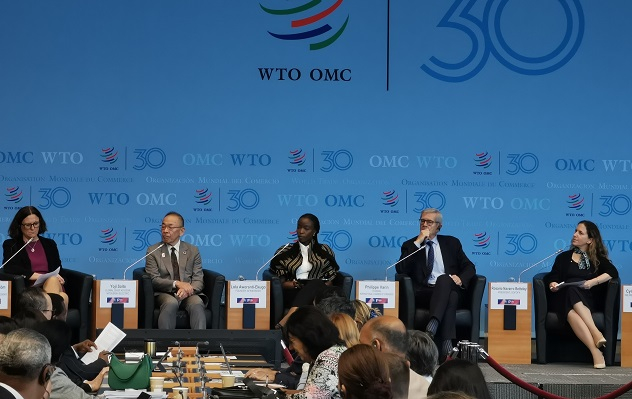
The Public Forum is the World Trade Organization’s largest platform for connecting decision-makers from the public and private sectors worldwide. This year’s edition takes place against the backdrop of significant recent developments, most notably the United States’ decision to impose steep tariffs on the majority of its trading partners—including Europe, China, and developing countries. These measures carry profound implications for the future of international commerce.
Organized over two days, this year’s Forum aims to explore the role of digital transformation in redefining the global trading system and in fostering connectivity, innovation, and international cooperation. Participants are set to assess both the risks and opportunities presented by a rapidly evolving suite of digital tools designed to empower small businesses, expand market access, and sustain a more resilient digital trade environment.
Compared to previous years, the number of sessions has been pared back slightly to ensure a sharper focus on core issues facing global trade today. More than 350 speakers are expected to share their insights on harnessing the transformative potential of digital trade.
Day One opened with a high-level discussion organized in partnership with the Peterson Institute for International Economics (PIIE), examining how business leaders across the globe are navigating a trading system where trust, predictability, and cooperation are being tested as never before.
The 2025 Forum zeroed in on how digital transformation, particularly artificial intelligence (AI), is redefining trade. While AI holds promise to streamline logistics, reduce trade costs, and expand market access, the Forum repeatedly stressed that its benefits will not be automatic. Bridging digital divides, ensuring fair competition, protecting jobs, and restoring trust in multilateralism are the pillars on which inclusive growth must rest.
The discussions revolved around three interconnected dynamics: trust, predictability, and transformation. From the opening plenary to sessions on Africa’s trade potential, digital economy agreements, and the social costs of trade conflicts, participants pointed to the same challenge: how to ensure the global trading system adapts to 21st-century realities while keeping inclusivity at its core.
Opening session
The first day of the Public Forum began with a panel organized in partnership with the Peterson Institute of International Economics (PIIE), exploring how business leaders around the world are navigating today’s global trading system, where trust, predictability and cooperation are increasingly tested.
A bent system, not a broken one
The Forum’s first morning, co-hosted with the Peterson Institute for International Economics, put the question of trust and predictability squarely on the table. Director-General Ngozi Okonjo-Iweala dispensed with hand-wringing. Roughly 72% of global goods still move under WTO terms, she noted, a reminder that the multilateral core continues to do much of the world’s commercial heavy lifting. But the core is under stress. Governments are reaching for unilateral tools; firms are absorbing more policy risk than they can easily price; consumers are learning that geopolitics now comes bundled with their household goods.
The business leaders on stage were clear about the costs of unpredictability. Cynthia Sanfilippo of L’Oréal offered a simple causal chain: predictable rules lower frictions; lower frictions raise trade; more trade raises growth and prosperity. When rules are rewritten overnight, complex ecosystems of suppliers, skills and jobs can fray in days. Rosario Navarro Betteley of Chile’s SOFOFA put a small, open economy’s dependence in stark terms: half of Chile’s GDP rides on trade. For such economies the multilateral rulebook is not a luxury; it is a life-support system. “There is no Plan B.”
From Japan, Yoji Saito of Mitsubishi described how a single sudden export restriction can ricochet through supply chains, forcing costly substitutions, delaying procurement and throwing production schedules into disarray. The victims are not only multinational primes; the shock propagates quickly to small suppliers with thin margins and little negotiating power. Philippe Varin, chair of the International Chamber of Commerce, gave the macro version: costs are mounting, especially for SMEs, and when “bandwidth” to cope with disruption runs out, exporters simply give up.
The collective message was clear: reforms must restore both credibility and agility to a system that shapes corporate strategies and supports household livelihoods. The mood was not one of despair but of urgency. No one in the room called for a return to some frictionless world that never truly existed. Instead, the call was for what global trade has always needed to thrive—credible rules, real transparency, and processes nimble enough to keep pace with technology without collapsing under political strain. That is precisely why the Forum’s other headline—the launch of the World Trade Report 2025—carried such weight.