HyveGeo: A UAE Startup Redefining Food Security and Carbon Neutrality
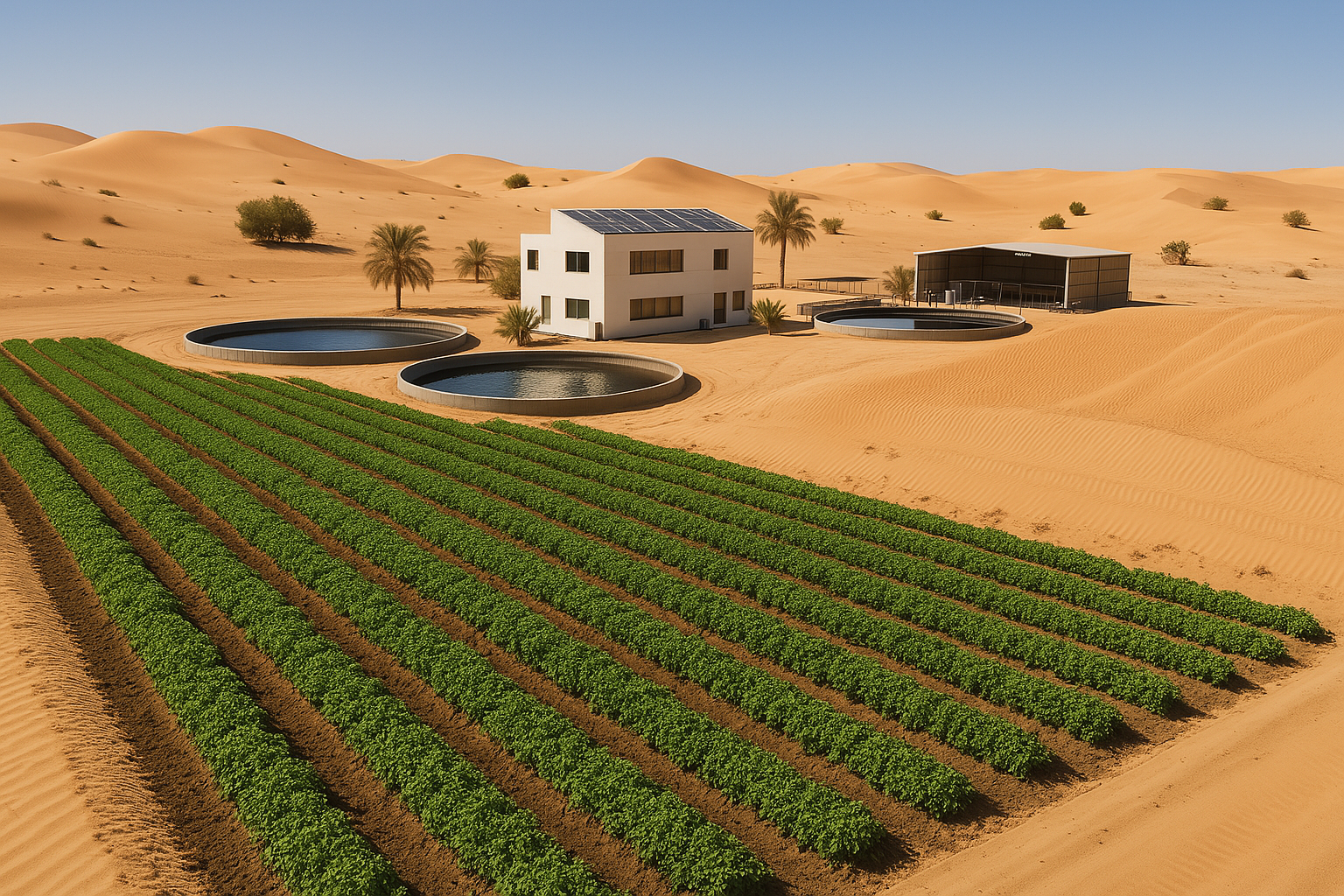
In one of the harshest environments on Earth, a quiet startup is reshaping the future of sustainable agriculture — not just in the UAE, but across arid regions globally. The company is called HyveGeo.
Operating between Cambridge in the UK and Abu Dhabi in the UAE, it offers a pioneering technological model that uses biochar and microalgae to transform desert sand into fertile soil, while actively sequestering carbon.
In a country where more than 80% of the land is desert and less than 1% is arable, and where over 90% of food is imported, innovation in agriculture isn't just a business opportunity — it's a matter of national survival.
HyveGeo’s approach involves processing organic waste from local palm farms through pyrolysis to produce biochar, a carbon-rich substance historically used to improve soil and now considered a key weapon in reducing agriculture’s carbon footprint.
To date, the pilot site in Abu Dhabi has generated over 200 tons of biochar, diverting 800 tons of organic waste from landfills. The company plans to scale up by launching its first commercial facility in 2026, with the capacity to process up to 40,000 tons of biomass annually.
But HyveGeo doesn’t stop at biochar. To make agriculture viable in the desert, it processes microalgae using biorefining techniques that extract biologically active compounds. These compounds function as natural fertilizers and growth stimulants, enhancing plant health and soil vitality.
Microalgae play a central role: they absorb CO2, release oxygen, and improve microbial activity in the soil. When combined with biochar and beneficial bacteria, they form customized soil solutions tailored for specific crops or even for creating forests in arid lands.
As co-founder Abdulaziz Bin Redha puts it: “We accelerate soil formation from five years to less than a month.”
In addition to agriculture, HyveGeo taps into the rapidly expanding global carbon credit market. By quantifying the carbon sequestration achieved through biochar, the company sells verified carbon credits, enabling international companies to offset their emissions.
This dual-income model — selling organic soil solutions and exporting carbon credits — positions HyveGeo at the intersection of environmental impact and economic value.
Despite early success, challenges remain. Scaling up microalgae production, adapting to market skepticism, and engaging policymakers in long-term thinking are all part of the journey.
In a March 2025 interview with CNBC Arabia, Bin Redha highlighted the UAE’s ideal conditions for algae farming: vast land, consistent sunlight, and high temperatures. Ongoing trials in collaboration with Abu Dhabi Agriculture and Food Safety Authority and Silal aim to validate HyveGeo’s formulations on crops like tomatoes.
The company’s ambitions are bold: rehabilitating 10,000 hectares of degraded land and sequestering one million tons of CO2 by 2035. Expansion plans include technology licensing in desertification-prone countries such as Sudan, Saudi Arabia, and parts of South Asia.
The next strategic frontier is Africa, where over 60% of the population is affected by land degradation, yet solar resources and urgency for food security make it a ripe ground for sustainable innovation.
Sources
- CNN Arabic – "UAE startup offers a solution to the carbon and food crisis"
https://arabic.cnn.com/science-and-health/article/2025/04/09/hyvegeo-green-desert-microalgae-charcoal-spc - CNBC Arabia – Interview with HyveGeo co-founder Abdulaziz Bin Redha (March 2025)
https://www.cnbcarabia.com/news/view/111116/hyvegeo-uae-startup-carbon-agriculture.html