Comoros
|
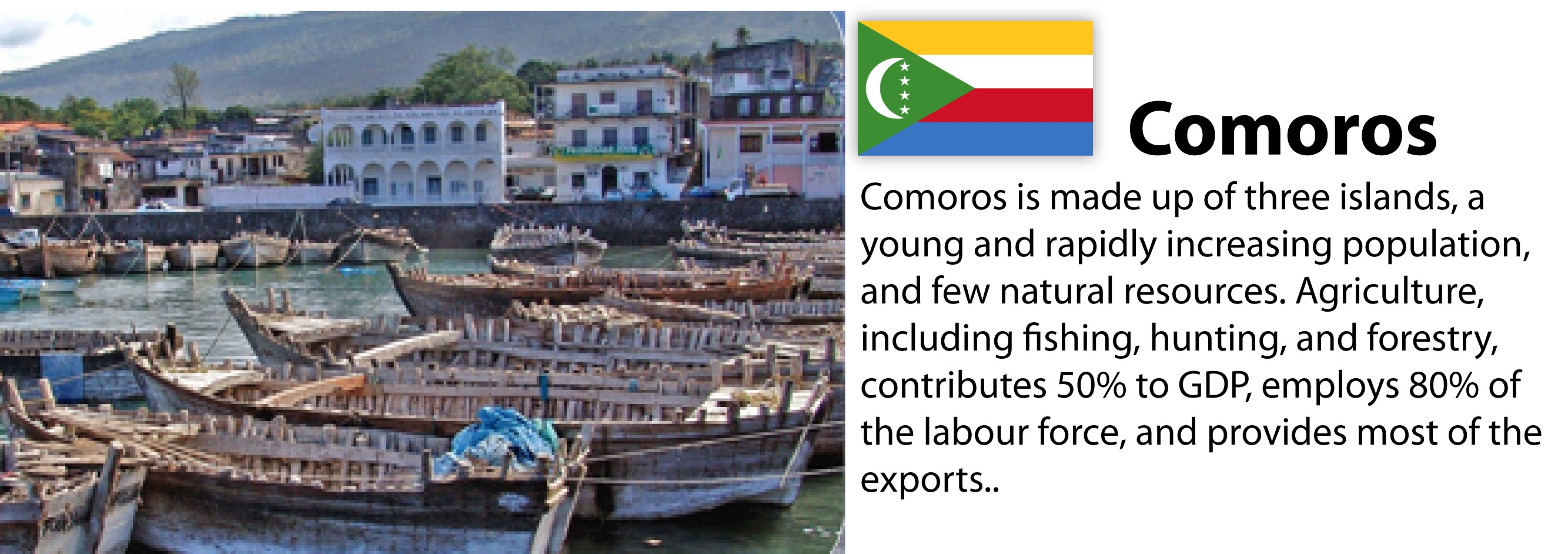
Comoros is made up of three islands that have inadequate transportation links, a young and rapidly increasing population, and few natural resources. The low educational level of the labour force contributes to a subsistence level of economic activity, high unemployment, and a heavy dependence on foreign grants and technical assistance. Agriculture, including fishing, hunting, and forestry, contributes 50% to GDP, employs 80% of the labour force, and provides most of the exports. Export income is heavily reliant on the three main crops of vanilla, cloves, and ylang-ylang; and Comoros' export earnings are easily disrupted by disasters such as fires. The country is not self-sufficient in food production; rice, the main staple, accounts for the bulk of imports. The government is struggling to upgrade education and technical training, privatize commercial and industrial enterprises, improve health services, diversify exports and promote tourism. Remittances from 150,000 Comorans abroad help supplement GDP. The international donor community currently plays a modest role in the country’s development. According to the OECD statistics, Comoros received approximately US$25 million in development assistance in 2005. France was by far the largest donor contributing almost $17 million followed by UN agencies (including the World Bank) with over $7 million and the EC with over $4 million. Further, the economy is also significantly dependent upon remittances from the estimated 150,000-strong Comorian Diaspora in France and elsewhere. Economic development in the past two decades has been hindered by a combination of recurrent political crises, macro-economic imbalances, and external shocks. A gradual recovery of the economy is observed since 2008. Real GDP is driven by agriculture and services increased by 0.6% in 2008, 1.1% in 2009 and 2.1% in 2010.
Essential Information Area: 2,170 sq km
|
|


 Current local time


Basic Economic Indicators
{arimodule id="838" comment="Comoros Economic Indicators (data)"}{/arimodule}
*PPP is purchasing power parity.
{mprestriction ids="1,2,3"}
Comoros: Real GDP Growth
{arimodule id="615" comment="Comoros Real GDP Growth "}{/arimodule}
Comoros: Nominal GDP ($ million)
{arimodule id="616" comment="Comoros Nominal GDP"}{/arimodule}
Comoros: GDP by kind of economic activity, 2010
{arimodule id="617" comment="Comoros GDP by kind of economic activity, 2010"}{/arimodule}
Comoros: Current Account Balance deficit ($ million)
{arimodule id="618" comment="Comoros Current Account Balance deficit "}{/arimodule}
Comoros: Current Account Deficit (% of GDP)
{arimodule id="619" comment="Comoros Current Account (% Of GDP)"}{/arimodule}
Comoros Exports and Imports and Trade Balance ($ million)
{arimodule id="620" comment="Comoros Exports and Imports and Trade Balance "}{/arimodule}
Foreign direct investment flows for Comoros ($ million)
{arimodule id="621" comment="Foreign direct investment flows for Comoros "}{/arimodule}
Swiss main exports/imports with the Arab world 2007-2014 (Million CHF)
{arimodule id="516" comment="Swiss main exports, imports with the Arab world 2014 (Million CHF)"}{/arimodule}
Swiss main exports/imports with Comoros Island 2007-2014 (Thousand CHF)
{arimodule id="521" comment="Swiss main exports/imports with Comoros Island 2007-2014"}{/arimodule}
Swiss main exportsto Comoros 2014 (CHF)
{arimodule id="550" comment="Swiss main exports to Comoros 2014 (CHF)"}{/arimodule}
Swiss main imports from Comoros 2014 (CHF)
{arimodule id="551" comment="Swiss main imports from Comoros 2014 (CHF)"}{/arimodule}
{/mprestriction}
Swiss Exports to the Arab world by commodity comparaisons between the Arab countries

Swiss Imports from the Arab world by commodity comparaisons between the Arab countries