Navigating the Digital and AI Revolution in the Arab World
Arab economies are undergoing significant structural shifts as the race toward digital transformation accelerates - shifts rich in opportunity yet laden with risk. Drawing on this year’s report by the International Labour Organization, “Navigating the Digital and Artificial Intelligence Revolution in Arab Labour Markets: Trends, Challenges and Opportunities,” the study highlights advances in telecommunications infrastructure, the expansion of digital services and the gradual adoption of artificial intelligence across the region. Together, these developments are opening new pathways for economic diversification, productivity gains and employment creation.
The Gulf Cooperation Council (GCC) stands out as the region’s standard-bearer in this transition.
Near-universal internet access, robust cybersecurity systems and ambitious national digital strategies have positioned Gulf economies at the forefront of innovation. Investment has fuelled rapid growth in e-commerce, fintech, healthcare technology, education and smart-city development—helping cultivate dynamic ecosystems for entrepreneurship and high-technology services. Several non-GCC countries, notably Jordan and Lebanon, have also made notable progress in digital payments, online commerce and public e-services, signalling the broader potential for digitalization to enhance economic inclusion across the Arab world.
Technological change is also reshaping labour markets. Digital transformation is gradually altering patterns of labour demand, with generative AI expected to be more augmentative than destructive. Only 2.2% of jobs are estimated to face a high risk of full automation, while roughly eight million positions - about 14.6% of total employment - show strong potential to be enhanced by AI technologies. Women hold a large share of these augmentation-friendly roles, offering a rare opportunity to narrow long-standing gender gaps. Macroeconomic modelling reinforces this optimistic outlook: scenarios for 2024–2035 suggest that expanding broadband access and deepening AI adoption would yield net job gains and substantial increases in GDP, with AI integration delivering the most pronounced long-term economic benefits.
Yet these promising trends are tempered by persistent structural obstacles. Labour markets across the region remain strained, with fewer than half of working-age adults employed. Women and young people, in particular, face some of the lowest employment rates globally. Deep disparities between GCC and non-GCC countries mirror differences in political stability, institutional capacity and infrastructure readiness. In many non-Gulf states, limited connectivity, weak cybersecurity, fiscal pressures and political turbulence continue to impede digital development.
Moreover, digitalization risks widening existing inequalities if foundational gaps in skills, governance and social protection are left unaddressed. Sectoral disruptions - especially in routine administrative work, retail and basic manufacturing - will require proactive policy responses. Older workers, low-skilled individuals, migrants and refugees remain among the most vulnerable to technological displacement.
The report concludes that ensuring digital transformation becomes a catalyst for fair and inclusive employment will require strengthening digital foundations, investing in human capital and designing targeted measures that protect and empower the most vulnerable groups.
Arab world readiness for Digital Transformation
A successful digital transformation rests on solid foundations: reliable broadband, affordable devices, skilled users, secure systems and effective governance. The International Telecommunication Union’s ICT Development Index (IDI) provides a useful lens on how Arab countries measure up. As shown in Table 1, GCC states register high scores - comparable to advanced economies - thanks to sustained investment in infrastructure, cybersecurity, e-government and digital service delivery. Jordan performs at an upper-middle level, reflecting meaningful progress despite fiscal and institutional constraints. Other Arab countries, particularly those affected by conflict or prolonged instability, score far lower, held back by weak connectivity, limited access, high cost barriers and fragile infrastructure. Yet the IDI tells only part of the story: national averages mask sharp disparities between cities and rural areas, men and women, and rich and poor households. High readiness on paper does not guarantee inclusive digital participation, particularly where advanced skills, financial inclusion or digital trust remain limited.
Table 1. ICT Development Index Scores (Illustrative Summary from Report Benchmarking, 2024)
|
Country Group |
Average IDI Score |
Performance Characteristics |
|
GCC States |
High (comparable to high-income economies) |
Strong infrastructure, cybersecurity, e-government and digital service delivery |
|
Jordan |
Upper-middle level |
Significant progress but constrained by fiscal and institutional limitations |
|
Other Non-GCC States |
Low |
Weak connectivity, limited access, high cost barriers, instability-related constraints |
Summary based on data from Table 2 in the report.
Labour markets on the edge of reinvention
Digital transformation is already reshaping labour markets. Only 44% of the region’s working-age population is employed—a figure that underscores structural weaknesses but also points to the scale of opportunity. Women and young people face some of the lowest employment rates globally, and nearly half of all jobs are informal. In this context, digitalization offers a pathway to broaden economic participation, encourage new types of work and improve job matching.
Contrary to common fears, the ILO finds that AI is more likely to augment jobs than eliminate them. Only 2.2% of Arab jobs face a high risk of full automation, while some 8 million positions—14.6% of total employment—hold strong potential for AI-driven enhancement. Women stand to benefit disproportionately, given their concentration in roles with high augmentation potential.
Macroeconomic modelling reinforces this optimism. Expanding broadband access could generate 186,000 new jobs and add $4.6bn to GDP by 2035. Deeper AI integration could yield even larger economic gains—$14.1bn in additional GDP—despite short-term disruption. Sectors such as construction, transport, engineering, education and personal services are poised to benefit, while routine clerical and retail roles may shrink.
The challenge lies in preparing workers—youth, older workers, migrants and low-skilled labourers—for these shifts. Without inclusive policies, the digital revolution could leave large segments of the population behind.
Building Governance for a Digital Era
Robust digital governance is emerging as a cornerstone of successful transformation. Gulf countries have invested heavily in building advanced regulatory frameworks covering telecoms, data protection, AI governance and digital government services. These systems are fostering investor confidence and enabling rapid technological deployment.
The GCC has built sophisticated regulatory regimes. Saudi Arabia, Bahrain and Oman have reached Generation 4 regulation—systems that span telecoms, data governance and cross-sectoral digital oversight. The UAE and Qatar are close behind. Jordan is the only non-GCC country to match this standard. Elsewhere, most countries sit at Generation 1 or 2, with regulators that struggle to keep pace with markets they do not fully understand.
This matters enormously. In the Gulf, coherent regulation has enabled a flourishing fintech scene, booming e-commerce and large-scale digital-government transformation. Dubai and Abu Dhabi have become regional financial-technology magnets; Saudi Arabia’s Vision 2030 reforms have unleashed a wave of freelancing and flexible work. More than 2.25 million people were registered on Saudi Arabia’s freelance platform by 2024, contributing roughly $19bn to GDP. But these benefits are reserved almost entirely for Saudi nationals and GCC citizens—limiting the inclusivity of this emerging economy.
Jordan, Lebanon and Palestine have pushed notable e-government reforms of their own—digital tax filing, business registration systems, electronic health records. But without strong regulation and investment, the risk is that digitalization will entrench market concentration, empower a few large firms and leave micro- and small enterprises struggling to keep up.
Public consultation remains weak across most of the region, often symbolic rather than substantive. This undermines trust in digital governance—at a moment when trust is the foundation for every online transaction.
Employment Impacts of Digitalization and AI
Digitalization is already reshaping labour markets across the Arab world through the displacement of some tasks, the augmentation of many others and the emergence of entirely new roles. High-digital-intensity employment remains most prominent in the UAE, where nearly one in five workers operates in technology-rich sectors; in most other Arab countries, the share is below 10%, with Lebanon a notable exception. Women are comparatively more represented in medium- and high-digital-intensity sectors, and thus stand to benefit disproportionately from the augmentative effects of artificial intelligence: while only 2.2% of jobs across the region face a high risk of full automation, some 8 million positions—around 14.6% of total employment—could be enhanced by AI, with 22.7% of women’s jobs showing strong potential for augmentation. Age, however, shapes exposure: youth, concentrated in lower-skilled roles, have less to gain, and older workers risk exclusion without significant reskilling. Looking ahead, two scenarios modelled by the ILO illustrate how digital transformation could play out. As shown in Table 2, expanding broadband access could add $4.6 billion to regional GDP and generate around 186,000 jobs by 2035, while deeper AI integration could yield a larger GDP boost—$14.1 billion—alongside a net gain of 118,000 jobs after short-term disruptions.
Table 2. GDP and Employment Outcomes under Digitalization Scenarios (2035)
|
Scenario |
GDP Impact |
Net Jobs Created |
|
Broadband Expansion |
+US$4.6 billion |
+186,000 |
|
AI Integration |
+US$14.1 billion |
+118,000 |
Source: ILO based on modelling analysis by Cambridge Econometrics.
These impacts will not be evenly distributed. Construction, transport, engineering and personal services are poised for growth, while routine clerical and retail roles may shrink as automation advances. Women fare better under broadband-driven expansion but face losses under AI integration due to the vulnerability of clerical occupations; men gain more in logistics and technical fields. Migrants, refugees, low-skilled workers and those in informal or temporary roles remain particularly exposed. And while digital tools can improve autonomy and flexibility, they also introduce risks—from algorithmic surveillance to work intensification—highlighting the need for robust labour protections as the digital transition accelerates.
A skills crisis in the age of algorithms
The digital transition is reshaping the region’s demand for skills, placing a premium on cognitive, digital and soft competencies. Across the GCC, employers increasingly seek capabilities such as problem solving, critical thinking, data analytics, coding, cybersecurity and leadership—core areas highlighted in Table 3, which outlines the top skills in Gulf labour markets for 2025.
Table 3. Top Core Skills in GCC Labour Markets (2025)
|
Skill Category |
Examples |
|
Cognitive |
Problem solving, critical thinking |
|
Digital |
Data analytics, coding, cybersecurity |
|
Soft |
Communication, adaptability, leadership |
More details figures: 9 and 10.
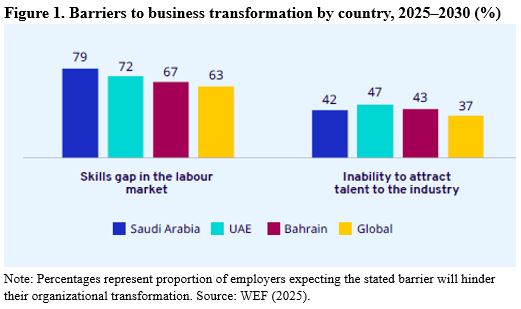
Yet despite this rising demand, the region faces an acute talent shortage. The pipeline of STEM graduates remains thin, performance in international assessments lags behind global peers and AI-related doctoral training is limited, with only two PhDs per million people compared with 25 in OECD countries. Skill deficits are even more pronounced in non-GCC economies, where infrastructure constraints and instability hamper investment in human capital. These gaps are already shaping business expectations: as illustrated in Figure 1, firms in Saudi Arabia, the UAE and Bahrain overwhelmingly identify skills shortages as the primary barrier to organisational transformation between 2025 and 2030. Difficulties in attracting qualified talent add another layer of strain, with nearly half of employers in the UAE and sizeable shares in Bahrain and Saudi Arabia reporting challenges in recruiting digital specialists—significantly higher than the global average. This intensifying competition for AI, data, cybersecurity and other advanced skills underscores a central lesson of the region’s digital transition: without sustained investment in education, vocational training, lifelong learning and inclusive upskilling strategies, digital transformation risks advancing faster than the workforce’s ability to keep pace.
MSMEs: Unlocking the Region’s Entrepreneurial Potential
Micro, small and medium-sized enterprises (MSMEs) form the backbone of most Arab economies. Their relationship with digitalization is complicated. On one hand, digital tools can give them access to markets, payments, logistics and customers previously out of reach. On the other, MSMEs often lack finance, technical know-how and reliable infrastructure. The result is a widening productivity gap between large firms—often the winners of digital transformation—and smaller ones struggling to modernize.
Without strong policy intervention, digitalization could accelerate the emergence of winner-take-all markets in which a handful of well-capitalized firms capture regional digital activity.
Conclusion and Policy Recommendations
Arab countries face a historic inflection point. Digital transformation and AI have the potential to generate substantial economic and employment benefits, but only with the right policy mix. Automation risks are manageable, but inequality risks are significant. The region must act decisively to ensure digitalization enhances both the quantity and quality of employment.
To maximize the benefits of digital transformation, Arab States should invest heavily in digital infrastructure and narrow the divide between and within countries. Building a digitally skilled workforce is critical, requiring educational reforms, stronger technical and vocational education and training (TVET) systems and lifelong learning pathways. Effective employment services, comprehensive social protection and robust labour market information systems will support workers through transitions.
MSMEs must receive targeted support - including financial incentives, digitalization programmes and access to innovation ecosystems - to prevent widening productivity gaps. Digital entrepreneurship and innovation should be nurtured through supportive regulation and business environments.
Stronger governance frameworks are essential. Arab States should modernize ICT and AI regulatory systems, ensure transparency in public consultations, integrate digital inclusion across all policies and uphold decent work standards in digital labour markets. Social dialogue among governments, employers and workers is necessary to navigate the transformative impacts of AI.
Regional and international cooperation will be indispensable for ensuring that digital transformation becomes a force for shared prosperity rather than a new source of inequality. Shared infrastructure, cross-border regulatory harmonisation, regional AI research and joint capacity-building initiatives can help narrow gaps and sustain momentum.
The Arab world’s digital transition is already underway; whether it becomes an engine of inclusion or a driver of divergence will depend less on technology itself than on the policy choices and collective action pursued in the years ahead.