Arab world economy
Essential Information
Origins
The origins nationalist notion of cultural and political unity among Arab countries lie in the late 19th and early 20th centuries, when increased literacy led to a cultural and literary renaissance among Arabs of the Middle East.
This contributed to political agitation and led to the independence of most Arab states from the Ottoman Empire (1918) and from the European powers (by the mid-20th century). An important event was the founding in 1943 of the Baath Party, which formed branches in several countries and became the ruling party in Syria and Iraq. Another was the founding of the Arab League in 1945. Pan-Arabism's most charismatic and effective proponent was Egypt's Gamal Abdel Nasser.
Arab League
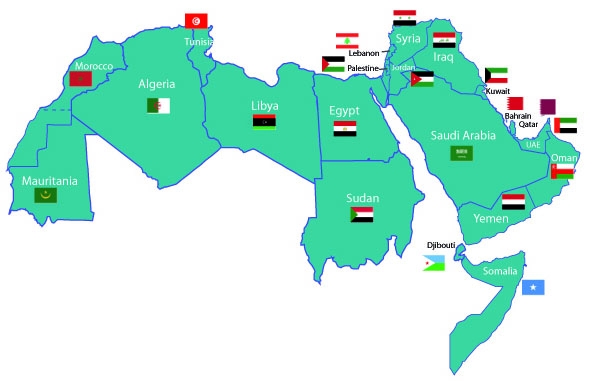
The Arab League or League of Arab States was a regional organisation formed on March 22, 1945 (Alexandria Protocol) and based in Cairo. It initially comprised Egypt, Syria, Lebanon, Iraq, Transjordan (now Jordan), Saudi Arabia, and Yemen; joining later were Libya, Sudan, Tunisia, Morocco, Kuwait, Algeria, Bahrain, Oman, Qatar, the United Arab Emirates, Mauritania, Somalia, Palestine, Djibouti, and Comoros. The league's original aims were to strengthen and coordinate political, cultural, economic, and social programs and to mediate disputes; a later aim was to coordinate military defence. The official language is Arabic. The total Population of the Arab League was estimated at 345.98 Million in 2007.
Emerging Arab world and business opportunities
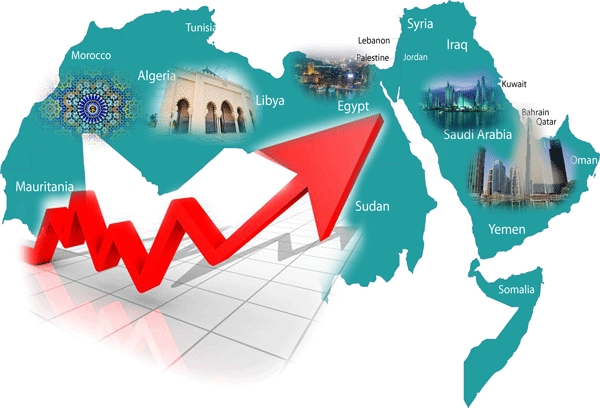
The Arab world, a home to more than 360 million people, representing 5% of the world’s population, with an area of about 13.3 million km2 (about 10% of the world inhabited land), and around 2799 billion dollars Gross Domestic Product (3.7% of global GDP), is playing a greater role in the world economy. Moreover, the Arab world will be a centre to the Islamic economy, estimated at US$3 trillion, a new economic paradigm that is likely to have a significant global impact over the next decade.
The abundant revenues of oil and gas made of the Arab world the largest region in terms of sovereign wealth funds in the world, with total assets estimated at about $1970 billion (38% of the total world assets). If well invested, the available huge funds are the stone corner to diversify the local economies in the Arab countries. In terms of investments in the Arab world as a whole, they have increased from $6.1 billion in 2000 to $79.3 billion in 2009, this level is comparable to that of China ($95 billion 2009) (UNCTAD data). The ongoing pattern of global growth, with emerging economies grow faster than their advanced counterparts, and the shift in the global economic power, ensures that Middle East and Africa are expected to be the fastest growing regions in 2018, which means huge needs in terms of investments mainly infrastructure, renewable energy, health, education, etc… just to mention a few.
With more than 135 million internet users in the Arab world, a new generation of entrepreneurs, passionate about technology, is emerging. This region is expected to post robust growth over the next decade both in terms of population and GDP. By 2015 the Arab population is forecast to reach 371m, about 50% increase over the level in 2000. Whereas the real GDP (based on PPP) is expected to grow by about 190%.
Doing business in the Arab world becomes a corner stone for the local governments. The battle is now between the economic ministers in terms of the most business-friendly economy. Several Arab governments implemented regulatory reforms in the past years aimed at improving the business environment. Investing the Arab funds locally and attracting FDIs are very crucial in order to satisfy the increasing needs for infrastructure, transport, education, health care, housing, business services, logistics, agriculture, oil and petrochemicals, financial sector, defense, industrial output as well as Islamic products.
In spite of the numerous advantages of the Arab world, the ongoing political turmoil hit hard many economies of the region. The absence of a demonstrated international competitiveness in either manufacturing or services as well as corruption constitute one of the main obstacles for doing business. Institutional reform, capacity building, reforming the education and the regulations facing business remains essential.
Moreover, the Arab world needs to create a dynamic private-sector in order to create sufficient employment. This will be done through high competitiveness, an educational system which meets the labour markets’ needs, and through encouraging applied sciences to transform ideas into real business projects, as well as through more consolidated trade and economic relations with the external world.
If the Arab region’s employment challenge can be successfully addressed, the region’s young demographic could then turn from a potential liability to a bonus. I believe it is time more than ever to invest in this region, not only because of the high return on investment, but also because the birth of the new economic paradigm, the future “G7”, passes through this region.
(more details)
Arab world major Statistics for 2013
{arimodule id="839" comment="Arab world major Statistics"}{/arimodule}
Arab World Population by country: 2012 {arimodule id="842" comment="Arab world Population Size (Thousand)"}{/arimodule} source: World factbook, CIA
Arab World GDP at PPP ($ Billion): 2012 {arimodule id="847" comment="Arab world: GDP at PPP ($ billion)"}{/arimodule}
Source: World factbook, CIA, data for Libya and Somalia are for 2011.
Arab World GDP per capita : 2012 {arimodule id="843" comment="Arab world: GDP per capita $(PPP)"}{/arimodule}
* Data for Somalia are for 2011.
Source: World factbook, CIA and International Monetary Fund.
{mprestriction ids="1,2,3,5"}
Arab World exchange rate: 2013 {arimodule id="841" comment="Arab world: Exchange rate ($) "}{/arimodule}
Arab world: Gross domestic product (international comparaison with other emerging economies) current prices ($bn), 1991-2015
{arimodule id="846" comment="Arab world: Gross domestic product (international) ($bn) 1991-2015"}{/arimodule}
Arab world: Real GDP growth (international comparaison with economic blocs) current prices ($bn), 2012-2018
{arimodule id="851" comment="Arab world: Real GDP growth by region (intercontinental comparaison) 2012-2018"}{/arimodule}
Arab world: Real GDP growth: comparaison between Oil-exporting countries
{arimodule id="845" comment="Ara world: Oil-exporting countries Real GDP Growth "}{/arimodule} source: IMF regional economic outlook 2012.
* Total for oil importing including Iran.
Arab world: Real GDP growth: comparaison between Oil-importing countries
{arimodule id="844" comment="Arab world: Oil-importing countries Real GDP Growth "}{/arimodule} Source: IMF regional economic outlook 2012.
1. In the IMF data under West Bank and Gaza.
2. Data for 2011exclude South Sudan after July 9. Data for 2012 and onward pertain to the current Sudan.
* Total for oil importing including Afghanistan and Pakista.
Arab world: Arab world Foreign direct investment flows (Million $) 2011
{arimodule id="848" comment="Arab world Foreign direct investment flows (Million $) 2011"}{/arimodule}
Arab world: Geographic distribution of FDI 2006
{arimodule id="849" comment="Arab world: Geographic distribution of FDI 2006"}{/arimodule}
Arab world: Global Competitiveness Index: 2014-2015 rankings (vs. 2012-2013 rankings)
{arimodule id="850" comment="Global Competitiveness Index: 2014-2015 rankings "}{/arimodule}
Arab World Largest Souveraign wealth funds {arimodule id="840" comment="Arab World: Largest Sovereign Wealth Funds"}{/arimodule}
Ease of Doing Business Rank 2015 {arimodule id="590" comment="Ease of Doing Business Rank 2015"}{/arimodule} Source: World Bank
Arab world: Free trade agreements with Switzerland {arimodule id="788" comment="Free Trade Agreements between Switzerland and other countries"}{/arimodule}Source: UNCTAD
Arab world: Swiss direct investment in the Arab world (international comparaison): Million SFr {arimodule id="789" comment="Swiss direct investment abroad: Million SFr"}{/arimodule}Source: UNCTAD
Arab world: Number of tourists arrivals from the Arab world in Geneva hotels for 2012 (hotel arrivals) (International comparaison) {arimodule id="787" comment="Tourists arrivals in Geneva hotels, foreign nationals for 2012"}{/arimodule}Source: UNCTAD
Energy Sector
Oil Reserves by country 2015 (Trillion Cubic Feet)
{arimodule id="603" comment="Oil Reserves 2015"}{/arimodule}
Source: EIA
Gas Reserves by country 2015 (Billion Barrels)
{arimodule id="602" comment="Gas Reserves 2015"}{/arimodule}
Source: EIA
Oil Price
Crude Oil Export Price (US$/bbl)
{arimodule id="599" comment="Crude Oil Export Price 2012-2019 "}{/arimodule} Source: IMF
Trade between Switzerland and the Arab world
Switzerland: Exports to the Arab countries 2007-2014: Swiss Francs
{arimodule id="785" comment="Trade between Switzerland and the Arab Countries"}{/arimodule}
Source of data: Swiss customs
Switzerland: Imports from the Arab countries 2007-2014: Swiss Francs
{arimodule id="790" comment="Switzerland imports from the Arab Countries (in million CHF) 2007-2014"}{/arimodule}
Source of data: Swiss customs
Switzerland Trade with the Arab World 2012: Swiss Francs
{arimodule id="786" comment="Trade Balance Switzerland and the Arab Countries 2012 "}{/arimodule}
Source of data: Swiss customs
Swiss total Exports to the Arab World by Country 2014: million Swiss Francs
{arimodule id="301" comment="Swiss total exports to the Arab world 2014, by country: Swiss Francs"}{/arimodule}
Source of data: Swiss customs
Swiss total Exports to the Arab World 2014: (Portion of total exports)
{arimodule id="300" comment="Swiss total exports to the Arab world 2014: Swiss Francs"}{/arimodule}
Source of data: Swiss customs
Swiss Total Imports from the Arab world by country 2014: Swiss francs
{arimodule id="292" comment="Swiss Imports from the Arab world 2014"}{/arimodule}
Source: Swiss customs
Swiss Total Imports from the Arab world 2014 (Portion of the total imports)
{arimodule id="302" comment="Swiss Total Imports from the Arab world 2014 (Portion)"}{/arimodule}
Source: Swiss customs
Swiss exports/imports with the Arab world (Million CHF)
{arimodule id="516" comment="Swiss main exports, imports with the Arab world 2014 (Million CHF)"}{/arimodule}
Source: Swiss customs
Swiss main exports to the Arab world 2014 (CHF)
{arimodule id="544" comment="Swiss main exports to the Arab world 2014 (CHF)"}{/arimodule}
Swiss main Imports from the Arab world 2014
{arimodule id="545" comment="Swiss main imports from the Arab world 2014 (CHF)"}{/arimodule} Source: Swiss customs
{/mprestriction}