Syria
|
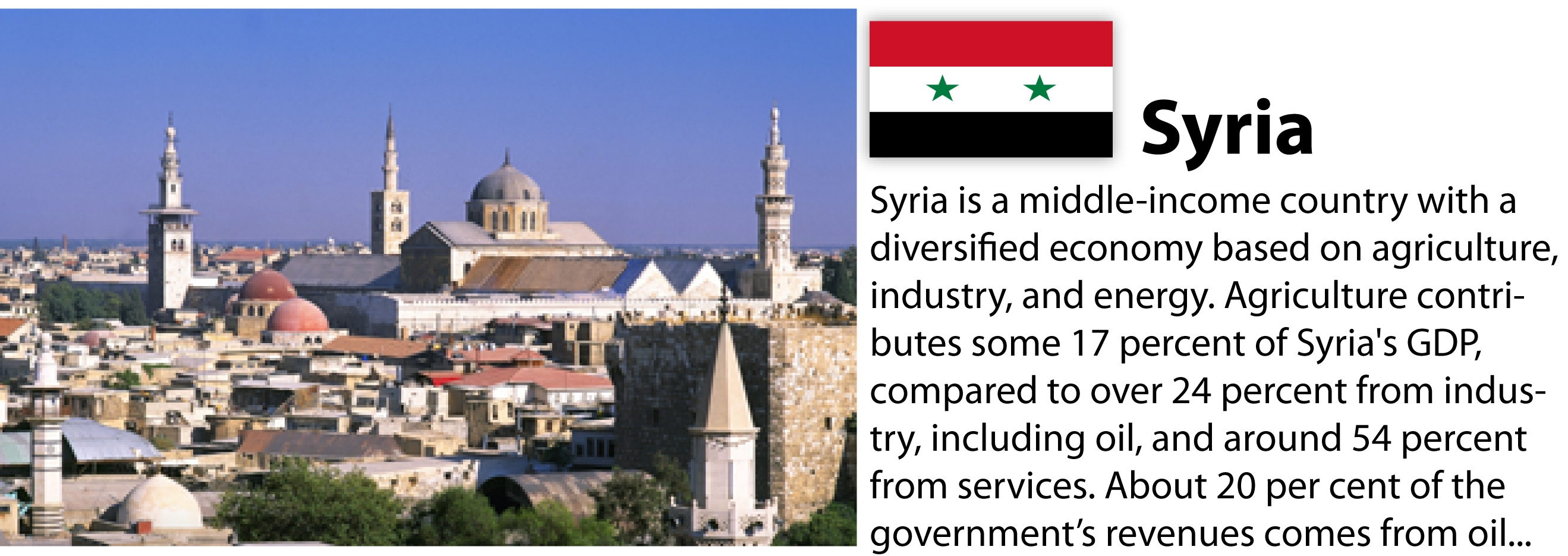
Economy of Syria Syria is a middle-income country with a diversified economy based on agriculture, industry, and energy. Agriculture contributes some 17 percent of Syria's GDP, compared to over 24 percent from industry, including oil, and around 54 percent from services. According to IMF data, the Syrian economy expanded by 3.4 percent in 2010 after growing 5.9 percent in 2009. The oil sector contributes about 20 per cent of the government’s revenues and about 40 per cent of its export receipts, according to data from the World Bank. Oil, exports of services and remittances are the main sources of foreign earnings and enable the government to finance its imports. The Syrian economy is totally exhausted after several years of revolution. All economic indicators are in the red in the violence-ravaged country. GDP has collapsed, inflation has skyrocketed, unemployment has risen, and the current account deficit continues to widen. These problems are compounded by EU sanctions, especially on the export of oil. The Syrian Center for Policy Research estimated that GDP has contracted 3.7% in 2011 and 18.8% in 2012 against original projections of an increase of 7.1% and 5.6%, respectively. Other indices are faring no better. Per capita income was forecast to drop from $4,784 in 2010 to $3050 in 2012. The budget deficit was forecast to grow significantly, and public debt, which represented 22.6 percent of GDP in 2010, was expected to exceed 50 percent in 2012 due to a 40 percent decrease in budget revenues and a 20 percent increase in spending. The Syrian economy is running at 30 percent capacity, and the banking system in the shadows. Public banks are under international sanctions, and private establishments are idling due to caution. The currency has eroded in value 50 percent against the dollar during the first two years of the turmoil despite two sales of $3 billion in gold and silver by the Central Bank. Total reserves, which stood at $19.5 billion, were predicted to fall to $9.6 billion in 2012 according to EIU estimates. The negative social and economic consequences of the violence are expected to have long-term consequences. The population growth has shrunk from 2.45% growth in 2010 to 2.5% shrinkage in 2012, with much of the educated, professional population taking flight. It is also worth noting the impact that sanctions have had on ordinary Syrian citizens. An estimated 28.3% of the first two years’ GDP loss is due to sanctions. Out of the 3.1 million newly poor individuals, 877,000 can be attributed to the effect of sanctions. Exports declined by 52% for Arab countries, 93% for EU countries, and 82% for Turkey. The sanctions make it much more difficult for Syria to import essential goods, including fuel and medicines, making these a luxury for many.
Essential Information Area: 185,180 sq km DEMOGRAPHY Age Distribution (2012 est.) NATURAL RESOURCES Visa Requirements: All non-Syrian and non-Arabic passport holders require visas. These can be obtained from the consulates abroad.
|
|


Basic indicators
Syria: Economic and International trade indicators {arimodule id="791" comment="Syria: Economic indicators "}{/arimodule}Source: IMF, CIA factbook.
Economic growth
Syria: Real GDP growth {arimodule id="792" comment="Syria: Real GDP growth"}{/arimodule}Source: IMF
Syria: GDP ($ Billion) {arimodule id="793" comment="Syria: Nominal GDP ($ Billions)"}{/arimodule}Source: IMF
Syria: Gross Domestic Product by economic activity 2010 {arimodule id="796" comment="Syria: GDP by kind of economic activity"}{/arimodule}Source: IMF
Syria: Current account balance ($ Billions) {arimodule id="794" comment="Syria: Current Account Balance"}{/arimodule}Source: IMF
Syria: Total Government Debt (% GDP) {arimodule id="795" comment="Syria: Total Government Debt (% of GDP)"}{/arimodule}Source: IMF
Syria: Unemployment rate {arimodule id="797" comment="Syria: Unemployment rate"}{/arimodule}Source: IMF
Syria: The Number of Syrian Refugees by Country: (In thousans, as of July 9, 2015) {arimodule id="798" comment="Syrian Refugees by Country: (Thousans)"}{/arimodule} Source: UNHCR, Eurostat.
Ease of Doing Business Rank 2015 {arimodule id="590" comment="Ease of Doing Business Rank 2015"}{/arimodule} Source: World Bank
Foreign Trade and Foreign Investment
Syria: Total exports and imports ($ billion) {arimodule id="799" comment="Syria: Exports and Imports ($ billion)"}{/arimodule}Source: IMF
Syria: Foreign Direct Investment (FDI) {arimodule id="800" comment="Syria: FDI ($ million)"}{/arimodule}Source: UNCTAD
Energy Sector
Oil Reserves by country 2015 (Trillion Cubic Feet)
{arimodule id="603" comment="Oil Reserves 2015"}{/arimodule}
Source: EIA
Gas Reserves by country 2015 (Billion Barrels)
{arimodule id="602" comment="Gas Reserves 2015"}{/arimodule}
Source: EIA
Oil Price
Crude Oil Export Price (US$/bbl)
{arimodule id="599" comment="Crude Oil Export Price 2012-2019 "}{/arimodule} Source: IMF
Syria: Oil supply and Exports (Thousand Barrels Per Day) {arimodule id="801" comment="Syria: Oil Supply and Exports"}{/arimodule}Source: IMF
Syria: Dry Natural Gas Production (Billion Cubic Feet) {arimodule id="802" comment="Syria: Dry Natural Gas Production (Billion Cubic Feet)"}{/arimodule}Source: IMF
Syria: Oil Exports by Destination (Percentage): 2010 {arimodule id="803" comment="Syria: crude oil exports by destination"}{/arimodule}Source: EIA
Trade between Switzerland and Saudi Arabia
Swiss total Exports to the Arab World by Country 2014: Swiss Francs
{arimodule id="301" comment="Swiss total exports to the Arab world 2014, by country: Swiss Francs"}{/arimodule}
Source of data: Swiss customs
Swiss total Exports to the Arab World 2014: (Portion of total exports)
{arimodule id="300" comment="Swiss total exports to the Arab world 2014: Swiss Francs"}{/arimodule}
Source of data: Swiss customs
Swiss Total Imports from the Arab world by country 2014: Swiss francs
{arimodule id="292" comment="Swiss Imports from the Arab world 2014"}{/arimodule}
Source: Swiss customs
Swiss Total Imports from the Arab world 2014 (Portion of the total imports)
{arimodule id="302" comment="Swiss Total Imports from the Arab world 2014 (Portion)"}{/arimodule}
Source: Swiss customs
Swiss main exports/imports with the Arab world (Million CHF)
{arimodule id="516" comment="Swiss main exports, imports with the Arab world 2014 (Million CHF)"}{/arimodule}
Swiss main exports/imports with Syria 1985-2014 (Million CHF)
{arimodule id="536" comment="Swiss main exports/imports with Syria 2007-2014"}{/arimodule}
Swiss main exports/imports with Levantines (Syria, Lebanon, Palestine, Jordan) 1985-2014 (Million CHF)
{arimodule id="541" comment="Swiss main exports/imports with Levantines 1984-2014"}{/arimodule}
Levantines (Syria, Lebanon, Palestine, Jordan)
Swiss main exports to the Arab world 2014 (CHF)
{arimodule id="544" comment="Swiss main exports to the Arab world 2014 (CHF)"}{/arimodule}
Swiss main Imports from the Arab world 2014
{arimodule id="545" comment="Swiss main imports from the Arab world 2014 (CHF)"}{/arimodule} Source: Swiss customs
Swiss main exports to Syria 2014 in Swiss Francs
{arimodule id="582" comment="Swiss main exports to Syria 2014 (CHF)"}{/arimodule}
Swiss main imports from Syria 2014 in Swiss Francs
{arimodule id="583" comment="Swiss main imports from Syria 2014 (CHF)"}{/arimodule}
Swiss Exports to the Arab world by commodity comparaisons between the Arab countries

Swiss Imports from the Arab world by commodity comparaisons between the Arab countries