Sudan
|
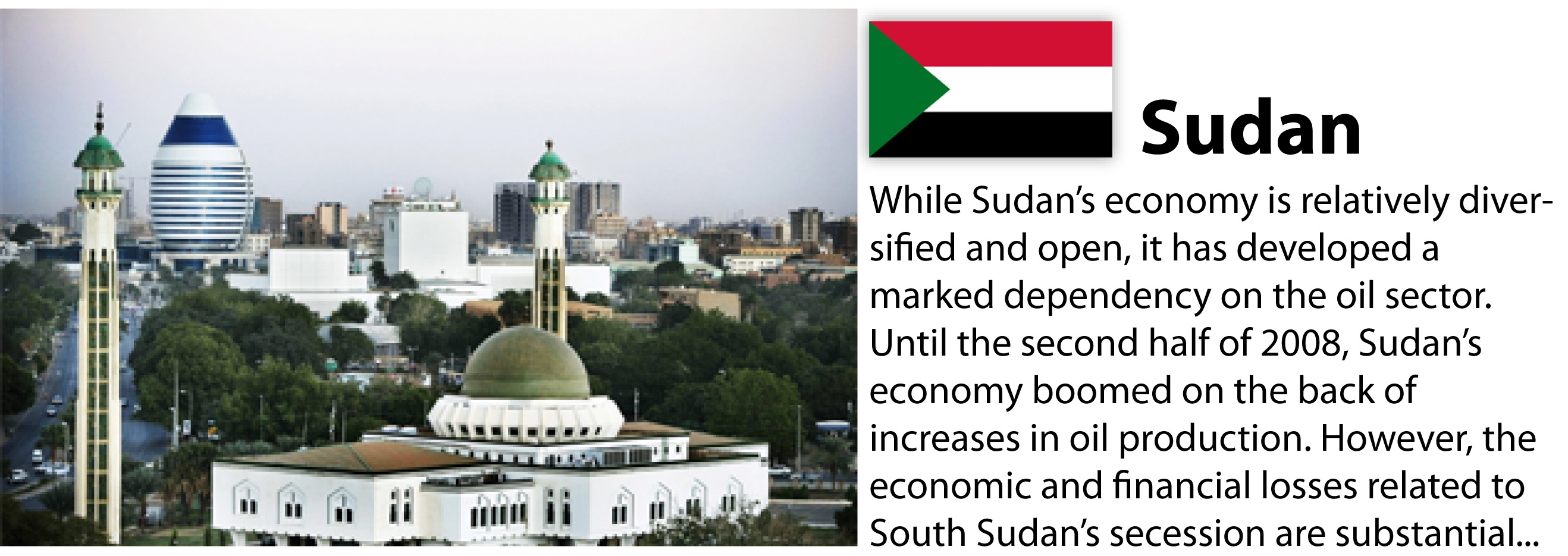
Economy of Sudan Despite being the 17th fastest growing economy in the world with new economic policies and infrastructure investments, and the Sudan’s economy is relatively diversified and open, it has developed since 1999 a marked dependency on the oil sector that has substantially increased its vulnerability to external and fiscal shocks. The oil sector‘s contribution to GDP has been modest, hovering around 15 percent. However, it provided sizeable budget revenues and contributed a major share of the country’s foreign exchange receipts. The economic and financial losses related to South Sudan’s secession are substantial and have affected all the sectors of the economy. The loss of output is concentrated in the oil sector and estimated at 75 percent, compared with 5–10 percent in the rest of the economy. Prior to the country's breakup, Sudan oil production was close to 500,000 barrels per day. In terms of value-added, the overall loss is about SDG 50 billion (about 26 percent of 2012 GDP), of which about 19 percent of GDP in the oil sector. The revenue loss for the government is estimated at SDG 12 billion (about 6 percent of GDP), corresponding to the foregone oil revenues net of the transfers to South Sudan and the savings on wages of South Sudanese civil servants. On the external sector side, the main impact is related to the loss of oil exports estimated at about US$6.6 billion (12.9 percent of GDP) in 2012. Sudan has opened the country's first gold refinery, which officials say is one of Africa's largest plants. Analysts say it is part of a strategy by the government to deal with the loss of oil revenue following the session of South Sudan in 2011. Faced with the loss of most oil reserves to South Sudan when it seceded in 2011, Sudan is trying to boost exports of gold and farming exports such as cotton, cash crops or gum Arabic from its vast farmlands. The loss of oil revenues, which used to be the main source for state revenues and dollars needed to pay for food imports, has thrown the economy into turmoil. The Sudanese pounds has more than halved in value since the secession. After a year of uncertainty, the authorities approved in late June 2012 a comprehensive reform program to address the deterioration of the country’s economic and financial situation. The program-which builds on the authorities’ Three-Year Emergency Program - includes an exchange rate devaluation of about 66 percent, an increase in key taxes, a sharp reduction in fuel subsidies, cuts in non-priority spending, and a strengthening of the social safety nets. Rich mineral resources are available in Sudan including: petroleum, natural gas, gold, silver, chromite, asbestos, manganese, gypsum, mica, zinc, iron, lead, uranium, copper, kaolin, cobalt, granite, nickel, tin, aluminum.Agriculture production remains Sudan's most important sector, employing 80% of the workforce and contributing 39% of GDP, but most farms remain rain-fed and susceptible to drought. Essential Information Area: 1,861,484 (2,505,813 sq km was the area of Sudan before the independence of the Republic of South Sudan with an area of 619,745 km2, 25% of the total area of the former Sudan).
Visas are required by visitors except those in transit and Egyptian and Tanzanian residents. Travellers are required to register with police headquarters within three days of arrival in the country.
|
|


 Current local time


Basic Economic Indicators
Sudan: Economic and International trade indicators {arimodule id="767" comment="Sudan: Economic indicators "}{/arimodule}
Source: IMF, CIA Factbook. Following the independence of the Republic of South Sudan in 2011, GDP and all other economic data correspond to a population size of 78% of the total population of the former Sudan with an area of 75% of the total area of the former Sudan.
{mprestriction ids="1,2,3"}
Economic growth
Sudan: Real GDP growth {arimodule id="768" comment="Sudan: Real GDP Growth"}{/arimodule} Source: IMF
Size of the economy: GDP ($ Billion) {arimodule id="769" comment="Sudan: Nominal GDP ($ Billions)"}{/arimodule}Source: IMF
Sudan: Gross Domestic Product by economic activity 2010 {arimodule id="772" comment="Sudan: GDP by kind of economic activity"}{/arimodule}Source: IMF
Sudan: Current account balance ($ Billions) {arimodule id="770" comment="Sudan: Current Account ($ billion)"}{/arimodule}Source: IMF
Sudan: Total Government Debt (% GDP) {arimodule id="771" comment="Sudan: Total Govt. Debt (% of GDP)"}{/arimodule}Source: IMF
Ease of Doing Business Rank 2015 {arimodule id="590" comment="Ease of Doing Business Rank 2015"}{/arimodule} Source: World Bank
Foreign Trade and Foreign Investment
Sudan: Total exports and imports ($ billion) {arimodule id="774" comment="Sudan: Exports and Imports ($ billion)"}{/arimodule}Source: IMF
Sudan: Foreign Direct Investment (FDI) {arimodule id="775" comment="Sudan FDI ($ million)"}{/arimodule}Source: UNCTAD
Energy Sector
Oil Reserves by country 2015 (Trillion Cubic Feet)
{arimodule id="603" comment="Oil Reserves 2015"}{/arimodule}
Source: EIA
Gas Reserves by country 2015 (Billion Barrels)
{arimodule id="602" comment="Gas Reserves 2015"}{/arimodule}
Source: EIA
Oil Price
Crude Oil Export Price (US$/bbl)
{arimodule id="599" comment="Crude Oil Export Price 2012-2019 "}{/arimodule} Source: IMF
Sudan and South Sudan : Oil supply and Exports (Thousand Barrels Per Day) {arimodule id="773" comment="Sudan: Oil Supply and Exports"}{/arimodule}Source: EIA
Sudan and South Sudan: Oil Exports by Destination 2013 {arimodule id="776" comment="Sudan Crude Oil Exports by Destination, 2013 "}{/arimodule}Source: EIA
Sudan and South Sudan: Oil Exports by Destination 2011 {arimodule id="777" comment="Sudan Crude Oil Exports by Destination, 2011 "}{/arimodule}Source: EIA
Trade between Switzerland and Sudan
Swiss total Exports to the Arab World by Country 2014: Swiss Francs
{arimodule id="301" comment="Swiss total exports to the Arab world 2014, by country: Swiss Francs"}{/arimodule}
Source of data: Swiss customs
Swiss total Exports to the Arab World 2014: (Portion of total exports)
{arimodule id="300" comment="Swiss total exports to the Arab world 2014: Swiss Francs"}{/arimodule}
Source of data: Swiss customs
Swiss Total Imports from the Arab world by country 2014: Swiss francs
{arimodule id="292" comment="Swiss Imports from the Arab world 2014"}{/arimodule}
Source: Swiss customs
Swiss Total Imports from the Arab world 2014 (Portion of the total imports)
{arimodule id="302" comment="Swiss Total Imports from the Arab world 2014 (Portion)"}{/arimodule}
Source: Swiss customs
Swiss exports/imports with the Arab world (Million CHF)
{arimodule id="516" comment="Swiss main exports, imports with the Arab world 2014 (Million CHF)"}{/arimodule}
Source: Swiss customs
Swiss main exports/imports with Sudan (Million CHF)
{arimodule id="543" comment="Swiss main exports/imports with Sudan 2007-2014"}{/arimodule}
Swiss main exports to the Arab world 2014 (CHF)
{arimodule id="544" comment="Swiss main exports to the Arab world 2014 (CHF)"}{/arimodule}
Swiss main Imports from the Arab world 2014
{arimodule id="545" comment="Swiss main imports from the Arab world 2014 (CHF)"}{/arimodule} Source: Swiss customs
Swiss main exports to Sudan 2014 in Swiss Francs
{arimodule id="580" comment="Swiss main exports to Sudan 2014 (CHF)"}{/arimodule}
Swiss main imports from Sudan 2014 in Swiss Francs
{arimodule id="581" comment="Swiss main imports from Sudan 2014 (CHF)"}{/arimodule}
{/mprestriction}
Swiss Exports to the Arab world by commodity comparaisons between the Arab countries

Swiss Imports from the Arab world by commodity comparaisons between the Arab countries