Mauritania
|
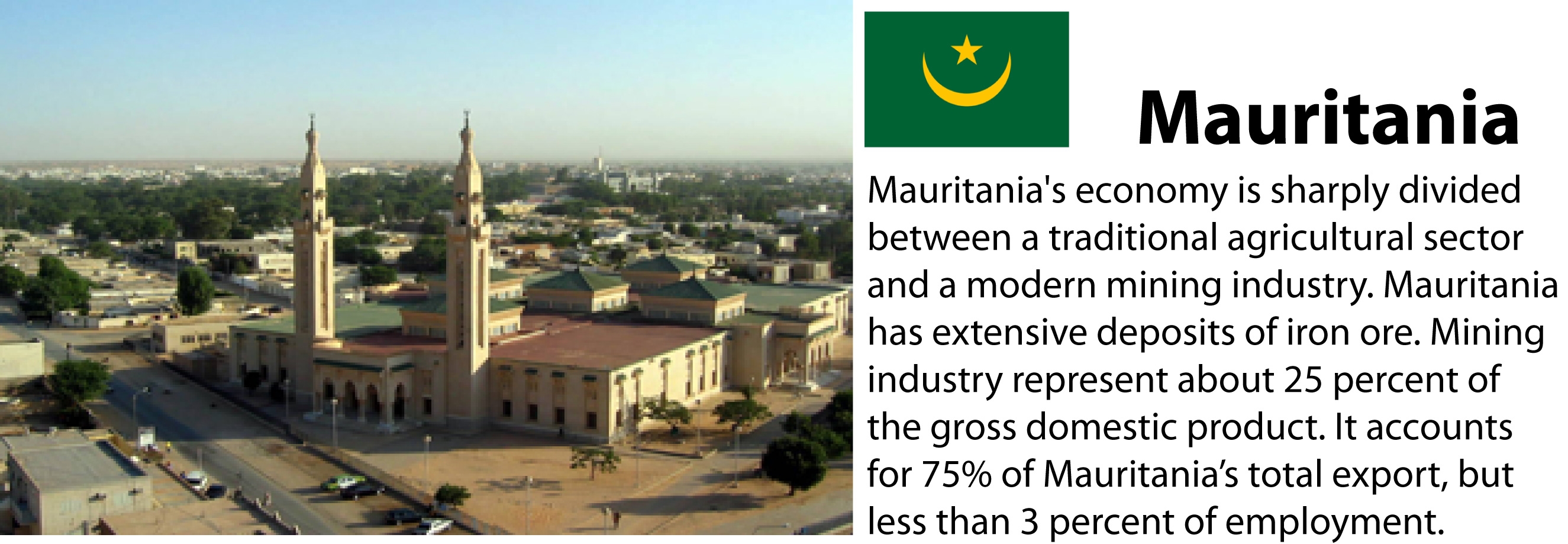
Economy of Mauritania The Mauritania economy is agricultural economy. Half the population still depends on agriculture and livestock for a livelihood, even though many of the nomads and subsistence farmers were forced into the cities by recurrent droughts in the 1970s and 1980s. The nation's coastal waters are among the richest fishing areas in the world, but overexploitation by foreigners threatens this key source of revenue. Mauritania has extensive deposits of iron ore. Mauritania’s mining industry represented 27 percent of the gross domestic product (2010). This portion was estimated to reach 28 percent of GDP in 2011 and expected to fall back to 25 percent in 2012. Mining industry accounts for 75% of Mauritania’s total export, but less than 3 percent of employment (2010). Almost one out of two Mauritanians lives below the poverty line, and a large segment of the population remains subject to food insecurity. GDP in the last ten years has increased remarkably in absolute values, however, real GDP growth is characterised by high volatility, with a stable trend line for nominal GDP. The structure of the Mauritanian economy, which is characterised by the predominance of the secondary and tertiary sectors (34.7% and 44.8% of GDP respectively), remained largely unchanged between 2009 and 2010. The secondary sector remained dominated by the extractive industries (24.8% of GDP in 2009) the largest part of which was attributable to metals mining (20% of GDP). Production of oil products declined, which resulted in a contribution of only 4.8% to GDP. Manufacturing and construction are limited and account for just 4.1% and 5.7% of GDP. Trade (11.2% of GDP), goods and services (12.7%) and public administration (16.1%) make up the principal activities of the tertiary sector, while livestock (10.7%) and fishing (5.3%) account for the majority of the primary. This GDP structure should remain stable for the coming years. The secondary sector should also benefit with the start of activities of certain mining investments. Essential Information Area: 1,030,700 sq km
Visas are required for all visitors which may be obtained from Mauritanian diplomatic and consular missions. Smallpox and yellow fever immunization is necessary. |
|


 Current local time


Basic Economic Indicators
Mauritania: Economic and International trade indicators {arimodule id="691" comment="Mauritania: Economic indicators "}{/arimodule}Source: IMF, CIA factbook.
{mprestriction ids="1,2,3"}
Economic growth
Mauritanai: Real GDP growth {arimodule id="692" comment="Mauritania GDP, constant prices (% change)"}{/arimodule}Source: IMF
Size of the economy: GDP ($ Billion) {arimodule id="693" comment="Mauritania: Nominal GDP ($ Billions)"}{/arimodule}Source: IMF Source: IMF
Mauritania: Gross Domestic Product by economic activity 2010 {arimodule id="694" comment="Mauritania: GDP by kind of economic activity"}{/arimodule}Source: IMF
Ease of Doing Business Rank 2015 {arimodule id="590" comment="Ease of Doing Business Rank 2015"}{/arimodule} Source: World Bank
Foreign Trade and Foreign Investment
Mauriania total exports and imports ($ billion) {arimodule id="697" comment="Mauritania: Exports and Imports ($ billion)"}{/arimodule}Source: IMF
Mauritania: Foreign Direct Investment (FDI) {arimodule id="700" comment="Mauritania FDI ($ million)"}{/arimodule}Source: UNCTAD
Energy Sector
Oil Reserves by country 2015 (Trillion Cubic Feet)
{arimodule id="603" comment="Oil Reserves 2015"}{/arimodule} Source: EIA
Gas Reserves by country 2015 (Billion Barrels)
{arimodule id="602" comment="Gas Reserves 2015"}{/arimodule} Source: EIA
Oil Price
Crude Oil Export Price (US$/bbl)
{arimodule id="599" comment="Crude Oil Export Price 2012-2019 "}{/arimodule} Source: IMF
Mauritania: Oil supply and Exports (Thousand Barrels Per Day) {arimodule id="698" comment="Mauritania: Oil Supply and Exports "}{/arimodule} Source: IMF
Mauritania: Oil revenu million $ {arimodule id="699" comment="Mauritania: Net revenu from oil million $ "}{/arimodule} Source: IMF
Trade between Switzerland and Mauritania
Swiss total Exports to the Arab World by Country 2014: Swiss Francs
{arimodule id="301" comment="Swiss total exports to the Arab world 2014, by country: Swiss Francs"}{/arimodule}
Source of data: Swiss customs
Swiss total Exports to the Arab World 2014: (Portion of total exports)
{arimodule id="300" comment="Swiss total exports to the Arab world 2014: Swiss Francs"}{/arimodule}
Source of data: Swiss customs
Swiss Total Imports from the Arab world by country 2014: Swiss francs
{arimodule id="292" comment="Swiss Imports from the Arab world 2014"}{/arimodule}
Source: Swiss customs
Swiss Total Imports from the Arab world 2014 (Portion of the total imports)
{arimodule id="302" comment="Swiss Total Imports from the Arab world 2014 (Portion)"}{/arimodule}
Source: Swiss customs
Swiss exports/imports with the Arab world (Million CHF)
{arimodule id="516" comment="Swiss main exports, imports with the Arab world 2014 (Million CHF)"}{/arimodule} Source: Swiss customs
Swiss main exports/imports with Mauritania (Million CHF)
{arimodule id="529" comment="Swiss main exports/imports with Mauritania 2007-2014"}{/arimodule} Source: Swiss customs
Swiss main exports to the Arab world 2014 (CHF)
{arimodule id="544" comment="Swiss main exports to the Arab world 2014 (CHF)"}{/arimodule} Source: Swiss customs
Swiss main Imports from the Arab world 2014
{arimodule id="545" comment="Swiss main imports from the Arab world 2014 (CHF)"}{/arimodule} Source: Swiss customs
Swiss main exports to Mauritania 2014 (Million CHF)
{arimodule id="566" comment="Swiss main exports to Mauritania 2014 (CHF)"}{/arimodule} Source: Swiss customs
Swiss main imports from Mauritania 2014 (Million CHF)
{arimodule id="567" comment="Swiss main imports from Mauritania 2014 (CHF)"}{/arimodule} Source: Swiss customs
{/mprestriction}
Swiss Exports to the Arab world by commodity comparaisons between the Arab countries

Swiss Imports from the Arab world by commodity comparaisons between the Arab countries