Solitude Doesn't Kill the Founder. Noise Does
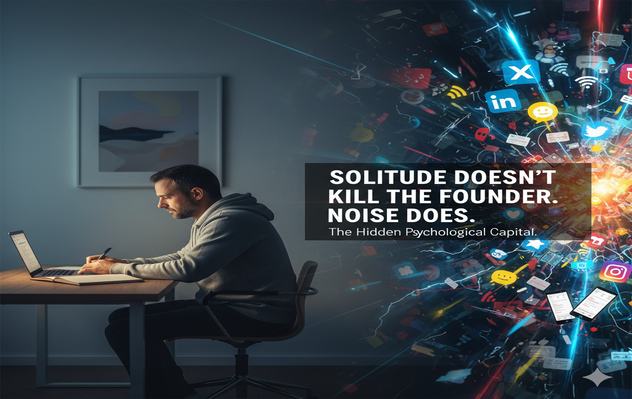
In a world that fetishizes "networking" and measures your success by the number of business cards collected—not the number of ideas you fought for—there is one truth no one dares to say out loud: A founder who cannot tolerate their own solitude will not tolerate their company. This isolation is not just a feeling; it is a hidden psychological capital that can make the difference between mediocre success and true leadership (Cardon & Arwine 2023).
All conventional startup advice focuses on presence, connections, partnerships, and the glossy success images displayed on social media. You are told: Attend every event, be present at every meeting, build your network, engage with investors, and smile for everyone. But the truth? All this noise is often lethal to genuine vision and creativity. In every conference, every session, every email, or network invite, a greater danger lurks than any founder anticipates: the noise that prevents you from confronting yourself, your ideas, and your deepest fears (Sahoo 2022).
Solitude, conversely, is not withdrawal, social weakness, or a problem to be "fixed." It is your private lab, where every idea is tested before the world sees it, and every fear is confronted without screens or external intermediaries. In solitude:
- The clamor of others' opinions ceases.
- Your idea is laid bare before you.
- Fear is exposed, and hesitation turns into a decision (Cacciotti et al. 2020).
Every moment of isolation is training in resilience, a confrontation with truth, and a conversion of doubt into conviction. As Csikszentmihalyi's Flow Theory demonstrated, intense focus in solitude generates a flow state, leading to unexpected ideas and solutions, while Cal Newport's Deep Work illustrates how isolated time multiplies strategic thinking productivity and fortifies mental toughness (Newport 2024).
Imagine the founder who decides to withdraw for hours, days, or weeks, away from meetings and social pressures: they are alone with their thoughts, with the project whose fate is perhaps catastrophic failure or massive success. In this isolation, true grit, the capacity for risk-taking, and the endurance of failure are tested. Every difficult decision—changing the business model, laying off staff, facing investors with a potential mistake—is first made in the silence of solitude, where no one can shield you from the truth (Cardon & Arwine 2023).
Solitude grants a clarity no network can provide. Noise obscures the truth, covering up any honest idea, any bold plan, any pivotal decision (Sahoo 2022). All great founders—from Jobs to Musk, and the founders who succeeded in near-impossible conditions—recognize this secret: Solitude is not your enemy; noise is the real enemy. The founder who runs from solitude runs from themselves and from the decisions that make the difference between an average company and one that endures and leaves an impact (Cacciotti et al. 2020).
Solitude is not merely silence; it is your private lab, the birthplace of rare ideas and bold decisions. Every moment of isolation represents an investment that is neither seen nor measured by money or networks, but is more impactful than any funding round (Newport 2024). In these moments, you learn that true value lies not in who you know, but in what you know about yourself, your idea, and your capacity to withstand potential failure.
The Three Fundamental Powers of Solitude Capital
The founder who embraces solitude knows it grants three core strengths:
- Clarity of Vision: Away from conflicting advice and social impressions, you can see reality as it is—unfiltered, unbiased by others' interests, and uncluttered. Every idea, every model, every decision becomes pure and distinct (Cacciotti et al. 2020).
- Protected Creativity: In solitude, you can experiment, fail, and re-experiment... without censorship, premature criticism, or social pressure. Bold ideas are born in silent vacuums. Research has shown that social isolation can have a positive effect on creativity, driving the mind toward original and innovative thinking (Sahoo 2022).
- Endurance of Risk and Failure: The solitary founder confronts fear alone, bears the weight of every decision, and discovers that true resilience comes not from external encouragement, but from facing oneself, one's fears, and potential mistakes without intermediaries (Cardon & Arwine 2023).
Modern psychological studies confirm that solitude enhances deep thinking and strategic decision-making:
- Flow Theory (Csikszentmihalyi): Intense focus in isolation generates a flow state, leading to unexpected solutions.
- Deep Work (Newport 2024): Isolated time multiplies strategic thinking productivity and fortifies mental toughness.
- Empirical Proof: The Power of Batching: This isn't just theory; it's the tactic of peak-performing leaders. Newport illustrates how highly productive founders like Adam Grant intentionally batch important intellectual work into long, uninterrupted stretches to free their minds from the devastating "Attention Residue" that multitasking creates (Newport 2024).
Transforming Isolation into a Strategic Force: Solitude Capital
Solitude is not just silence; it is your private lab, the birthplace of rare ideas and bold decisions. Every moment of isolation represents an investment that is neither seen nor measured by money or networks, but is more impactful than any capital can provide (Cacciotti et al. 2020).
Real-World Examples:
- Steve Jobs: While founding Apple, he spent long hours isolated in thought rooms, reviewing every product design detail, far from the noise of meetings. This solitude created his ability to see what others could not and led to globally disruptive products.
- Elon Musk: Weeks of continuous, isolated work, often complicated and criticized by those around him, yet he leveraged the solitude to refine his vision for the future—from PayPal to Tesla and SpaceX. Solitude here was not punishment; it was a laboratory for sharpening bold ideas and strategic risks.
In every case, one pattern emerges: Solitude is not an obstacle, but a platform for creative decision-making, confronting risk, and sharpening psychological fortitude. These individuals did not become great because of meetings, but because of silence... and the courage to face themselves and their ideas without external interference (Cardon & Arwine 2023; Newport 2024).
Solitude exposes fear, but it grants strength: the strength to see what truly matters, to make decisions others dare not, and to build something measured not by money, but by mental toughness and resilience. As research suggests, periods of isolation and loneliness can create an increased opportunity for entrepreneurship, where this state becomes a catalyst for innovative solutions (Cacciotti et al. 2020; Sahoo 2022).
Polishing Your Solitude Capital: Actionable Steps
Solitude isn't magical; it must be polished to become a true strategic force, based on scientifically studied practices (Newport 2024; Csikszentmihalyi 1990):
- Set Daily Solitude Blocks: Dedicated hours without phones or meetings for deep thinking and idea refinement.
- Idea and Decision Journaling: Writing down fears and doubts to convert them into clear decisions, strengthening clarity of vision.
- Deliberate Fear Confrontation: Testing difficult decisions first in the silence of solitude before external execution, developing the founder's capacity for risk-taking and failure endurance (Cardon & Arwine 2023).
- Routine Performance Review: Evaluating accomplishments, failures, and necessary improvements away from social pressure, reinforcing deep strategic thinking (Cacciotti et al. 2020; Sahoo 2022).
In this way, isolation transforms from a feeling of loneliness into a true hidden psychological capital, multiplying clarity, decisiveness, and mental flexibility under pressure.
References
Cacciotti, Gilda, David L. Deeds, G. T. Lumpkin, and G. Steven McMillan. 2020. "Loneliness and isolation in the time of COVID-19: the potential for entrepreneurship." Psychology, Health & Medicine.
Cardon, Melissa S., and Rebecca P. Arwine. 2023. "The many faces of entrepreneurial loneliness." Personnel Psychology. DOI: 10.1111/peps.12614.
Csikszentmihalyi, Mihaly. 1990. Flow: The Psychology of Optimal Experience. New York: HarperPerennial.
Newport, Cal. 2024. "Deep Work: Rules for Focused Success in a Distracted World." Todoist. Accessed November 18, 2025. https://www.todoist.com/inspiration/deep-work.
Sahoo, Pradyut. 2022. "The effect of loneliness, social isolation, and boredom on creativity during COVID-19." Contemporary Journal of Interdisciplinary Discourse VI (1). https://cjids.in/volume-vi-2022/the-effect-of-loneliness-social-isolation-and-boredom-on-creativity-during-covid-19/the-effect-of-loneliness-social-isolation-and-boredom-on-creativity-during-covid-19-2/.