Libya
|
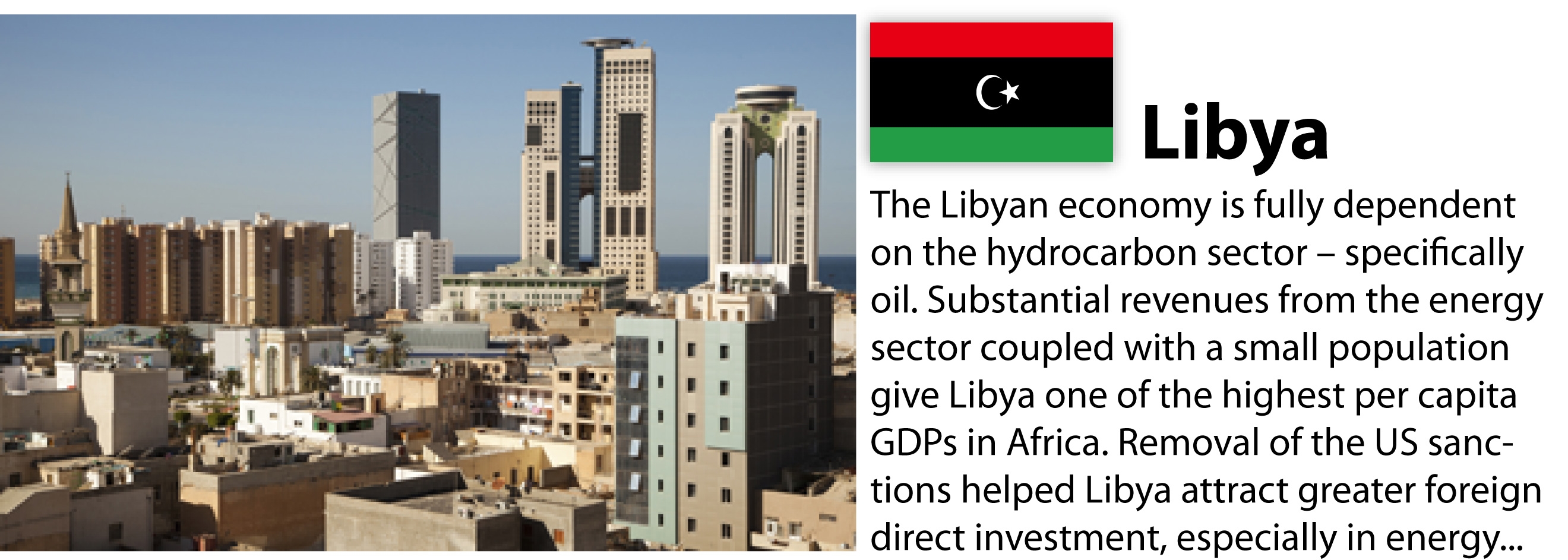
The Libyan economy is fully dependent on the hydrocarbon sector – specifically oil. Substantial revenues from the energy sector coupled with a small population give Libya one of the highest per capita GDPs in Africa, but under the former regime little of this income flows down to the lower orders of society. The process of lifting US unilateral sanctions began in the spring of 2004; all sanctions were removed by June 2006, helping Libya attract greater foreign direct investment, especially in the energy sector. During 2004–10, average growth was approximately 5 per cent, and foreign assets increased from $20 billion at end-2003 to $170 billion by end-2010. The non-hydrocarbon sectors grew rapidly––albeit from a low base––on the back of an ambitious public investment program, but the country remained dependent on hydrocarbons, which accounted for over 70 per cent of GDP, more than 95 per cent of exports, and approximately 90 per cent of government revenue. Development of the nascent private sector was constrained by the dominance of the state and by institutional weaknesses. As of end-2010, unemployment was estimated officially at 13.5 per cent with youth unemployment at 25–30 per cent. During the revolution, the prolonged fighting had a far-reaching impact on standards of living, provision of basic services, and employment: economic activity contracted sharply in 2011 and consumer prices increased, primarily due to international sanctions and supply constraints. The restoration of hydrocarbon output underpinned the recovery of economic activity in 2012, with a resulting doubling of real GDP. Consumer price inflation has been falling, with a year-on-year rate of -3.7 per cent in December 2012. The overall budget balance moved to a surplus of 20.8 per cent in 2012, from a deficit of 18.7 per cent of GDP in 2011. Similarly, the current account surplus widened to 36 per cent, from 9 per cent of GDP in 2011. Finally, broad money grew by 11.5 per cent with a modest shift from currency into deposits, and credit to the private sector increased by some 24 per cent. Libya faces a long road ahead in liberalizing its primarily socialist economy, but the revolution has unleashed previously restrained entrepreneurial activity and increased the potential for the evolution of a more market-based economy. Climatic conditions and poor soils severely limit agricultural output, and Libya imports about 80% of its food. Libya's primary agricultural water source is the Great Manmade River Project. But despite these challenges there are many reasons for optimism including Libya’s strategic position, its population with 50 per cent between the age of 18 and 45 years old and oil reserves of 60 billion barrels. Economic Diversification Actually Libyan oil sector constitutes about 50% of GDP, and 80% of government revenue. Diversification is an important issue because at current rates of production, Libyan oil reserves are not expected to last beyond the second decade of this century. Thus, the long-term health of the Libyan economy hinges on developing a self-sustaining non-petroleum sector. Otherwise, once oil reserves are depleted, Libya will become as poor as it was before its current oil boom. The non-oil sector plays a role in the national growth. The attempts to boost the non-oil sector have given some results. For most of the last five years, new IMF figures show, the non-oil sector has been growing much faster - with growth rates from 6 to 10 percent - than the hydrocarbon sector. The non-oil developments are dominated by foreign workers. However, two factors are of paramount importance. First Libya's GDP exhibits a very high level of volatility, with growth rates ranging from -36% to 60% in the last 20 years. Second, the performance of the country's GDP clearly trails that of world oil prices, which leaves the country open to a great deal of external risk and uncertainty. From a policy perspective, post-oil diversification should be made a national priority and should be coupled with a government strategy geared towards job creation for the youth. To this end, the transitional authorities face several complex issues.
Essential Information Area: 1,775,000sq km Education:
Passports must be accompanied by an official Arabic translation of the essential details. Most passport issuing authorities provide this on request, in the form of a visa-like stamp. Visas are required by holders of most non-Arab passports.
|
|


 Current local time


Basic Economic Indicators
Libya: Economic and International trade indicators {arimodule id="680" comment="Libya: Economic indicators "}{/arimodule}Source: IMF, CIA factbook.
{mprestriction ids="1,2,3"}
Economic growth
Libya: Real GDP growth (oil and Non-oil growth) {arimodule id="681" comment="Libya: Real GDP growth (oil and non-oil growth) "}{/arimodule}Source: IMF
Libya: GDP growth (Historical data) {arimodule id="682" comment="Libya: Real GDP Growth (1980-2017)"}{/arimodule}Source: IMF
Size of the economy: GDP ($ Billion) {arimodule id="683" comment="Libya: Nominal GDP ($ Billions)"}{/arimodule}Source: IMF Source: IMF
Libya: Gross Domestic Product by economic activity 2010 {arimodule id="684" comment="Libya: GDP by kind of economic activity"}{/arimodule}Source: IMF
Ease of Doing Business Rank 2015 {arimodule id="590" comment="Ease of Doing Business Rank 2015"}{/arimodule} Source: World Bank
Foreign Trade and Foreign Investment
Libya total exports and imports ($ billion) {arimodule id="685" comment="Libya: Exports and Imports ($ billion)"}{/arimodule}Source: IMF
Libya: Foreign Direct Investment (FDI) {arimodule id="686" comment="Libya: FDI ($ million)"}{/arimodule}Source: UNCTAD
Energy Sector
Oil Reserves by country 2015 (Trillion Cubic Feet)
{arimodule id="603" comment="Oil Reserves 2015"}{/arimodule}
Source: EIA
Gas Reserves by country 2015 (Billion Barrels)
{arimodule id="602" comment="Gas Reserves 2015"}{/arimodule}
Source: EIA
Oil Price
Crude Oil Export Price (US$/bbl)
{arimodule id="599" comment="Crude Oil Export Price 2012-2019 "}{/arimodule} Source: IMF
Libya: Oil supply and Exports (Thousand Barrels Per Day) {arimodule id="687" comment="Libya: Total Oil Supply and exports"}{/arimodule}Source: IMF
Libya: Dry Natural Gas Production (Billion Cubic Feet) {arimodule id="688" comment="Libya: Dry Natural Gas Production and Exports "}{/arimodule}Source: IMF
Libya: Oil Exports by Destination 2010 {arimodule id="690" comment="Libya: Oil exports by destination 2010"}{/arimodule}Source: EIA
Libya: Oil Exports by Destination 2013 {arimodule id="689" comment="Libya: Oil exports by destination 2013"}{/arimodule}Source: EIA
Trade between Switzerland and Libya
Swiss total Exports to the Arab World by Country 2014: Swiss Francs
{arimodule id="301" comment="Swiss total exports to the Arab world 2014, by country: Swiss Francs"}{/arimodule}
Source of data: Swiss customs
Swiss total Exports to the Arab World 2014: (Portion of total exports)
{arimodule id="300" comment="Swiss total exports to the Arab world 2014: Swiss Francs"}{/arimodule}
Source of data: Swiss customs
Swiss Total Imports from the Arab world by country 2014: Swiss francs
{arimodule id="292" comment="Swiss Imports from the Arab world 2014"}{/arimodule}
Source: Swiss customs
Swiss Total Imports from the Arab world 2014 (Portion of the total imports)
{arimodule id="302" comment="Swiss Total Imports from the Arab world 2014 (Portion)"}{/arimodule}
Source: Swiss customs
Swiss exports/imports with the Arab world (Million CHF)
{arimodule id="516" comment="Swiss main exports, imports with the Arab world 2014 (Million CHF)"}{/arimodule}
Source: Swiss customs
Swiss main exports/imports with Libya 1985-2014 (Million CHF)
{arimodule id="528" comment="Swiss main exports/imports with Libya 2007-2014"}{/arimodule}
Swiss main exports/imports with North Africa (Algeria, Morocco, Tunisia, Libya) 1985-2014 (Million CHF)
{arimodule id="542" comment="Swiss main exports/imports with North Africa 1984-2014"}{/arimodule}
North Africa (Algeria, Morocco, Tunisia, Libya)
Swiss main exports to the Arab world 2014 (CHF)
{arimodule id="544" comment="Swiss main exports to the Arab world 2014 (CHF)"}{/arimodule}
Swiss main Imports from the Arab world 2014
{arimodule id="545" comment="Swiss main imports from the Arab world 2014 (CHF)"}{/arimodule} Source: Swiss customs
Swiss main exports to Libya 2014 (Million CHF)
{arimodule id="564" comment="Swiss main exports to Libya 2014 (CHF)"}{/arimodule}
Swiss main imports from Libya 2014 (Million CHF)
{arimodule id="565" comment="Swiss main imports from Libya 2014 (CHF)"}{/arimodule}
{/mprestriction}
Swiss Exports to the Arab world by commodity comparaisons between the Arab countries

Swiss Imports from the Arab world by commodity comparaisons between the Arab countries